

Australian Natural Gas Statistics (2025 Data & Forecast)
The State of Natural Gas in Australia: 2025 Snapshot
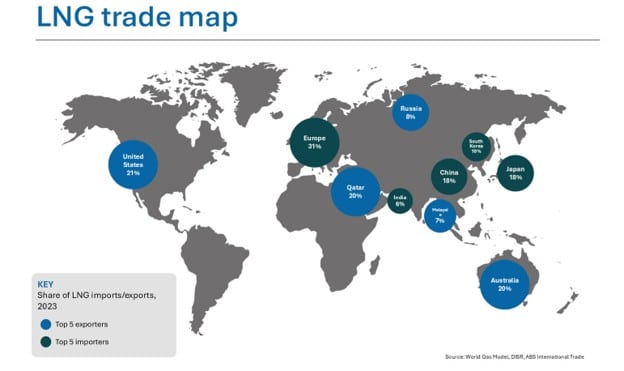
Data from recent years show that Australia was able to produce approximately 6,123 petajoules (PJ) of natural gas, exporting roughly 4,509 PJ as Liquefied Natural Gas (LNG), which is equivalent to over 70% of the country’s production (2023-24).
Moreover, the remaining 30% accounts for domestic consumption, such as power, industry, and household usage.
This highlights Australia’s significant role in global energy exports.
As such, Australia is still one of the leading LNG exporters, together with the United States and Qatar.
Source: [1]
With Australia being able to produce natural gas 2.4 times higher than the recorded volume a decade ago, it can support the economy, even as domestic gas users, including households and manufacturing, compete for access where infrastructure differs across regions.
While natural gas supports electricity generation and industrial processes, millions of Australians, particularly in regional and remote areas, remain reliant on LPG as an effective alternative where pipeline access is limited or unavailable.
Natural Gas Production: Where Does Australia’s Gas Come From?
Australia is known as one of the world’s largest natural gas producers, with the majority of its output driven by major offshore and onshore basins.
In 2022, the country’s national gas production reached roughly 6,362 PJ [2], making it one of the top countries that produce natural gas on a global scale.
Over the previous years, production growth has been greatly supported by Western Australia’s offshore projects and Queensland’s coal-seam gas (CSG) developments.
Western Australia also produces over twice the quantity of gas it did a decade ago.
Total Gas Production (Petajoules)
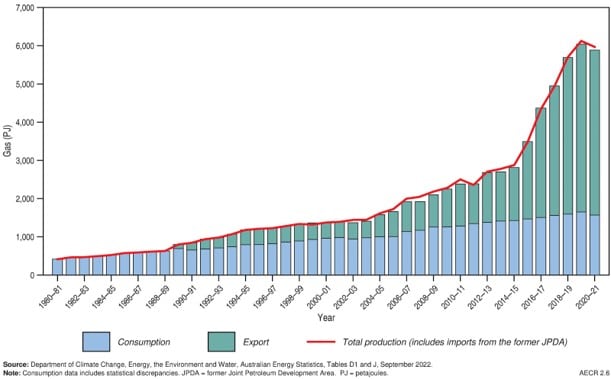
The total gas production of Australia has been increasing each year since the 1980s, reaching a peak of 6,154 PJ in 2021.
Still, the succeeding years have shown noticeable signs of slight plateauing because of maintenance and outages at key facilities in the country.
The graph below shows the total gas production of Australia from the 1980s to 2021, with a detailed legend on the number of export volumes and consumption numbers.
Source: [3]
Based on historical data, Western Australia dominates the local market, as it is responsible for over 60% of the total gas production in the country.
This is followed by Queensland, which supplies over 20%, mostly directed to the liquid natural gas production.
On the other hand, Victoria, South Australia, and the NT contribute much smaller yet regionally vital volumes of gas produced.
Australia’s Role as a Global LNG Exporter
With Australia’s high export volumes, it has established itself as a key player in LNG exports.
About 70-80% of its natural gas production is turned into LNG and exported to different countries [2].
The remaining 20 to 30% is for domestic consumption, underpinning the country’s export dominance of LNG.
This export-centred dynamic contributes to ongoing tensions around local supply and pricing, especially for Eastern Australia.
However, shortages are predicted to occur through the depletion of some reserves by 2028 to 2030 [4], prompting calls for new investment, domestic safeguards, and strategies.
Proven Gas Reserves
Australia holds substantial gas reserves, totaling approximately 78,000 PJ of conventional reserves and over 30,000 PJ of CSG reserves as of 2022.
These record high volumes suggest a production life of about 16 to 20 years at present output levels [5].
Most conventional reserves, which are approximately 93%, are located offshore along the North West Shelf, with the remaining reserves scattered across the CSG-rich basins in Eastern Australia.
Although exploration continues, especially in areas like the Beetaloo and Bowen Basins, the reserve base has seen regular declines in previous years [5].
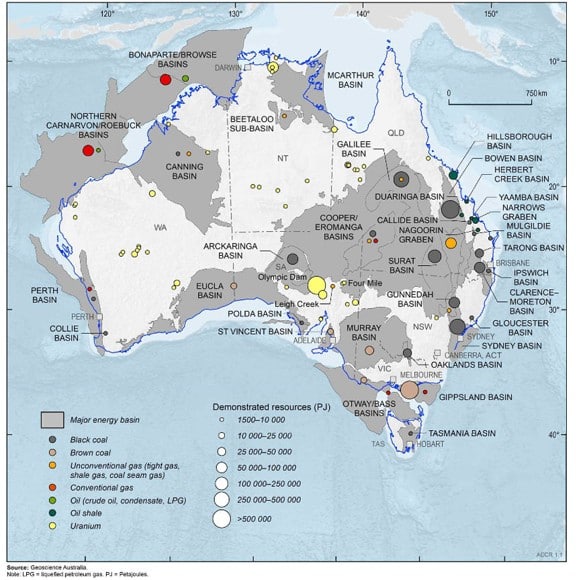
The graphic below shows the distribution of Australia’s major non-renewable energy resources in 2022.
The demonstrated resources below roughly contain over 1,500 petajoules.
The orange and red legends on the map represent unconventional gas and conventional gas reserves, respectively.
Source: [2]
How Natural Gas is Used in Australia
The use of natural gas in Australia is significant in various sectors, including power generation, industry, and households.
Yet, its reach varies across the country.
Total Domestic Consumption by Sector
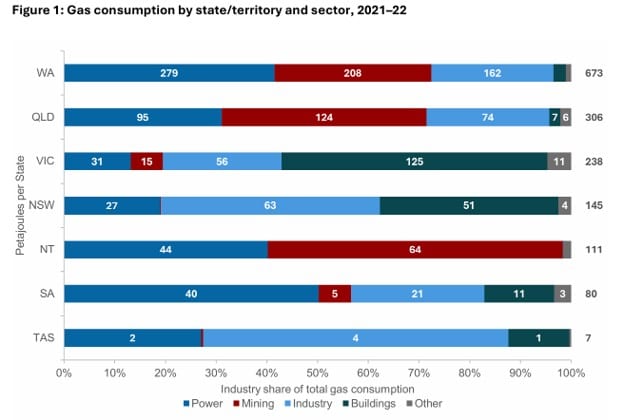
Natural gas is responsible for roughly 24.7% of Australia’s total energy consumption, which contributes around 1,478 PJ out of 5,977 PJ in 2023-24.
Below is the breakdown of the total gas consumption by sector in Australia by region.
Source: [6]
From the chart above, it can be interpreted that 39% of domestic gas emissions are linked to industrial use, suggesting significant energy consumption for various industrial processes.
On the other side, power generation accounts for roughly 38% of gas utilisation emissions, which also suggests reliance on gas for flexible generation.
Moreover, residential and commercial sectors make up 21% of the gas emission share; however, rising pressures are driven by access to electricity and policy changes.
The sectoral gas consumption across regions in Australia highlights the dominant industrial and power generation uses, with residential or commercial trailing, yet still substantial.
Residential Consumption: Who Uses Natural Gas at Home?
In Australia, roughly 5 million residents are connected to the natural gas pipeline [7], but connectivity across regions varies:
- Victoria: Roughly 80% of households are connected to the gas pipeline, which is around 2 million homes.
- New South Wales: Approximately 42% of households in NSW are connected to the gas pipeline.
- Western Australia: In Western Australia, the majority of households are connected to the natural gas pipeline, which serves about 75% of the residents.
- Tasmania and Northern Territory: These territories have nearly zero connections to the natural gas pipelines, with as few as about 12,000 homes connected in Tasmania.
The average Australian household consumes about 32 gigajoules of natural gas per year in running their homes [8].
However, this figure is different across regions, where Victoria has the highest consumption among other states at 54 GJ/pa, while Queensland only consumes about 9 GJ/pa.
The ELGAS Perspective: The Limits of the Gas Network
The natural gas network in Australia primarily focuses on serving metropolitan and major regional centres, leaving various rural and remote areas out of reach.
Such a limitation of the gas network underscores LPG’s vital role by offering regional households and businesses a dependable energy source where a natural gas pipeline is not available or limited.
This highlights the flexibility, delivery infrastructure, and independence of LPG from pipeline build, making it a practical choice for millions of residents outside the gas grid.
The Reach of Australia’s Natural Gas Pipelines
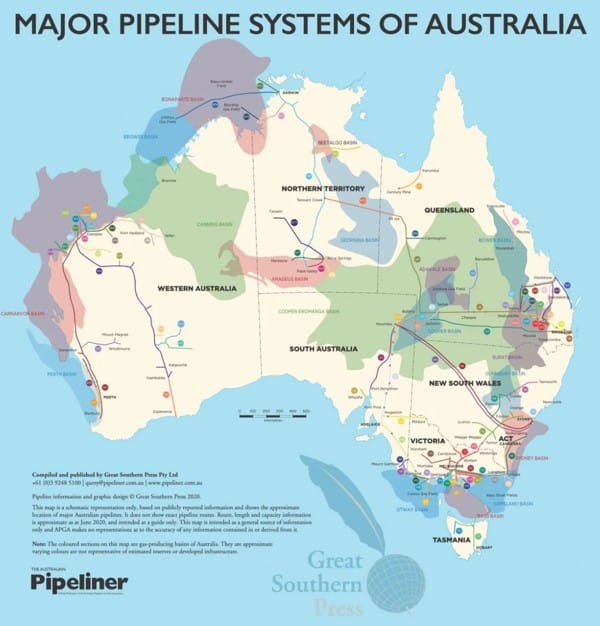
The gas network across Australia spans thousands of kilometres, linking major basins to cities through pipelines, such as the North West Shelf lines in WA, Queensland’s CSG pipelines to Gladstone, and the Moomba-Sydney/Adelaide routes.
However, coverage across regions in Australia remains highly uneven.
While urban centres are well-served by the natural gas pipeline, many parts of central and northern Australia remain unconnected.
This limited footprint means millions of Australians remain away from the main grids and are reliant on fuel alternatives like LPG for reliable energy access.
Map of Australia’s Major Gas Pipelines
The map provided below shows Australia’s extensive yet geographically concentrated natural gas infrastructure, where major transmission lines stretch from production basins in Western Australia and Eastern Queensland into key demand hubs.
It can be noticed that various regions, particularly in central and northern Australia, are entirely outside the gas pipeline system.
Source: [8]
The “Last Mile” Challenge
Even in regions with access to gas pipelines, connecting individual properties to the network can be costly.
Extending services costs about $12 to $35 per linear foot, with total installation costs that range from $1,000 to over $5,000, depending on distance and terrain [9].
For properties in remote or sparsely populated areas, costs are often greater than potential benefits.
These challenges mean that many properties, even those that are geographically near to trunk pipelines, remain energetically and financially isolated from natural gas.
Commentary: Why LPG Offers Energy Independence
Unlike the costly infrastructure of fixed pipelines, LPG offers a practical alternative with its portability, flexibility, and delivery-ready features, making it an ideal choice for regional and rural households in Australia.
They are sold in cylinder or bulk tanks, typically delivered to any location without any site connection fees or trenching required.
The flexibility of LPG enables households and businesses in areas outside the pipeline grid to secure reliable energy without depending on distant and costly grid infrastructures.
As a result, LPG remains a steadfast and accessible energy choice for Australians who are beyond the reach of the main pipeline network.
Understanding Natural Gas Prices
In Australia, the natural gas pricing is connected to both the wholesale market dynamics and the regulated delivery costs of gas to end-users.
From international demand to government regulations, domestic prices are influenced by various factors, despite the country being one of the world’s largest LNG exporters.
Wholesale vs. Retail Gas Prices
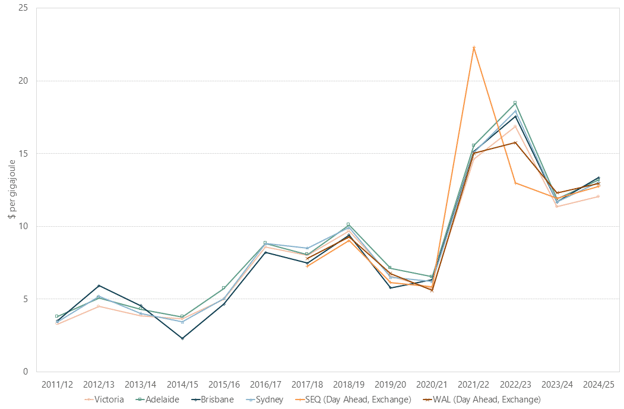
The wholesale price of gas reflects its cost when traded in hubs such as AEMO’s Short Term Trading Market (STTM) and the Victorian Declared Wholesale Gas Market (DWGM).
The graph below shows the financial year average prices for the Victorian gas market, STTM hubs in various regions of Australia, and the Wallumbilla Gas Supply Hub.
Source: [10]
Gas prices in Australia have shown significant volatility, averaging at about AUD8-12 per gigajoule (GJ) in previous years, with observed spikes during supply shortages and periods of high global LNG demand.
At the consumer level, retail prices remain higher than wholesale values, as they incorporate network charges, transmission costs, and retail margins.
Factors Influencing Your Gas Bill
For households that are connected to the mainline gas pipe networks, your retail bills are made up of various factors, such as wholesale gas costs, network charges, and retail margins and fees [11].
The wholesale gas costs are linked to international benchmarks, particularly from the Japan-Korea marker. Network charges are distribution and transmission fees that the AER regulates.
Overall, even if wholesale gas prices are lower, household bills may not decrease just as fast because of the fixed network and retail components of household gas consumption.
Price Comparison: Natural Gas vs. LPG
A unit of natural gas is often lower where households can access the mains network, making it a popular choice across cities and large regional centres.
On the other hand, it is not the same case for millions of Australians who live outside the main network; thus, reliance on LPG is high.
- LPG addresses portability and universal availability, regardless of pipeline access.
- Unlike natural gas connections, LPG does not have fixed supply charges.
- Flexibility for households to pay only for the gas that they consume.
While natural gas may be an attractive choice for many because of its cost-efficiency for connected users, LPG is still the practical and reliable option for areas outside the mains network, both regional and rural households.
The Outlook for Natural Gas in Australia
Presently, natural gas remains a vital component of Australia’s energy mix and will continue to be one in the years ahead.
Yet, its role is geared towards energy transition, the development of policies, and the growing need for reliable alternatives.
The Role of Gas in the Energy Transition
Gas remains a vital component in the energy transition, serving as a firming fuel for renewable energy sources.
As solar and wind energy expand swiftly, natural gas offers the flexibility to meet demand during times when the renewable output is low.
The Australian Energy Market Operator, or AEMO, projects that while overall demand for gas-fueled power may begin to decrease, its role remains strategic in maintaining stability in power grids through the succeeding years [12].
Domestic Gas Security and Policy
Policy continues to play a key role in securing domestic supply in the country.
The Gas Market Code of 2023 was able to introduce new rules on wholesale contracting, while the Australian Domestic Gas Security Mechanism (ADGSM) provides the government with powers to restrict LNG exports when local shortages are expected.
Both measures are designed to balance Australia’s role as a major LNG exporter with the need to maintain affordable and reliable energy for both households and industry.
There have been ongoing investment efforts for exploration and pipeline infrastructure.
This will help in determining the availability and affordability of gas in the Australian domestic market.
The Enduring Role of LPG Alongside Natural Gas
While natural gas supports the majority of the grid-connected energy system, millions of Australians live outside of this pipeline network.
For those who live beyond the pipeline network, LPG remains the preferred choice due to its efficient features, including accessibility, portability, and flexibility.
On a side note, LPG complements natural gas, and does not compete with it.
LPG helps ensure energy access in areas where mains gas is impractical or inaccessible.
Looking beyond, the development of renewable LPG, or rLPG, is creating a pathway towards decarbonisation in off-grid markets [13].
As rLPG becomes ready for commercial use, it will help in strengthening LPG’s role as a long-term partner to natural gas, positioning itself as a reliable partner by offering continuity, energy security, and alignment with Australia’s net-zero objectives.
Data Sources & References
- [1] Department of Industry, Science and Resources – Resources and Energy Quarterly, March 2025
- [2] KPMG – Economic contribution of the gas industry
- [3] Geoscience Australia – Gas
- [4 ]The Guardian – Southern Australian households to face gas shortages from 2026 as most production set for export
- [5] Geoscience Australia – Australia’s Energy Commodity Resources 2024 Overview
- [6] Department of Industry, Science and Resources – Future Gas Strategy
- [7] Department of Industry, Science and Resources – How Australian gas is used today
- [8] Climate News Australia – Australia’s Gas Supply: An Overview
- [9] ANGI – How Much Does It Cost to Get Utilities on Land? [2025 Data]
- [10] Australian Energy Regulatory – Gas market prices
- [11] Selectra – What’s the Average Gas Bill in Australia?
- [12] AEMO – Integrated System Plan (ISP)
- [13] Gas Energy Australia – Future Gas Strategy

Eric Hahn has over a decade of experience in the LPG industry and has become a key figure in shaping how LPG is marketed and communicated. As the creator of one of the world’s first LPG blogs, Eric has authored over 200 technical posts, helping educate and inform the industry and consumers.
Eric has served on multiple committees for Gas Energy Australia and the World LPG Association (WLPGA), contributing to important discussions and advancements within the global LPG sector. He has presented at WLPGA Annual Conferences, sharing his expertise as a speaker, panellist, and panel chair.
- Winter on the Manning River: Beautiful but Brisk - July 6, 2026
- The Harsh Reality of June in the Snowy Mountains - July 6, 2026
- The True Cost of a Freezing Guest in the Snowy Mountains - July 6, 2026
Steve Reynolds
Technical Consultant
Steve Reynolds is a leading expert in the LPG industry with over 22 years of experience. As part of the national management team at ELGAS, Steve ensures the safe and efficient storage, handling, and transportation of LPG. He serves as the lead investigator for incidents and collaborates with authorities on industry developments.
Steve is a technical advisor to Standards Australia and Gas Energy Australia (GEA), and an active member of the World LPG Association (WLPGA), contributing to global standards and technical reviews. He holds a BSc. (Hons) in Industrial Chemistry from UNSW and has held senior safety and technical roles at ELGAS, making him a trusted authority in LPG safety and standards.