
Worldwide Autogas Statistics (2025 Trends, Forecast & Usage)
Key Statistics and Trends for the Global Autogas Fleet
Autogas is a proven clean energy solution for countries moving away from fossil-based fuels in the long term.
Since it is derived from oil refining and natural gas processing, it still generates CO2 emissions, albeit at a lower rate than most conventional fuels.
Until zero-emission vehicle technologies can be commercialised on a larger scale, Autogas will stay to meet the growing vehicle demands globally.
In fact, the Autogas sector powers millions of vehicles, particularly in high-mileage commercial fleets and regions that lack the necessary infrastructure to support electric vehicles.
Ultimately, the vehicle fleet is expected to be fully electrified to achieve ultra-low or zero emissions.
However, it will take decades to develop the massive infrastructure required to produce these electric vehicles, not to mention the power generation and recharging facilities needed.
Until then, alternative, affordable options like Autogas remain critical to fill the gap.
Rather than waiting until the gasoline-powered vehicles in use are scrapped, emissions can be reduced immediately by switching to Autogas.
Let’s take a glimpse at the current state of the global Autogas market, keeping pace with the sheer scale of vehicle demand.
- Global Fleet Size: There are roughly 27 million Autogas vehicles on the road, which are supported by 82,000 refuelling stations globally [1].
- Top Countries: Four countries currently lead the charge in LPG vehicle adoption, namely Turkey, South Korea, Poland, and Italy, in that particular order [2].
- Commercial Backbone: Vehicles with high mileage, such as taxis, couriers, and public transport vehicles, cover a large share of the Autogas market, benefitting from fuel cost savings of up to 40% compared to petrol and 25% to diesel [3].
- Fuel Price Advantage: Autogas is priced around 40-50% less than petrol, making it a cost-effective and accessible low-emissions fuel available in the market today [1][4].
- The Green Future: The release of BioLPG or rLPG, which is chemically identical to conventional LPG but extracted from sustainable bio-feedstocks, is a promising solution towards decarbonisation goals [5].
A Decade of Autogas: Vehicle Numbers and Regional Shifts
Autogas remains one of the largest alternative-fuel transport systems globally.
Recent data reveal that the sector is stabilising and growing in some markets, which could be driven by its low carbon emissions and lower fuel costs compared to petrol and diesel.
Top 10 Countries by Autogas Vehicle Numbers
The graph below shows the countries that lead the Autogas industry based on vehicle counts and national reporting.
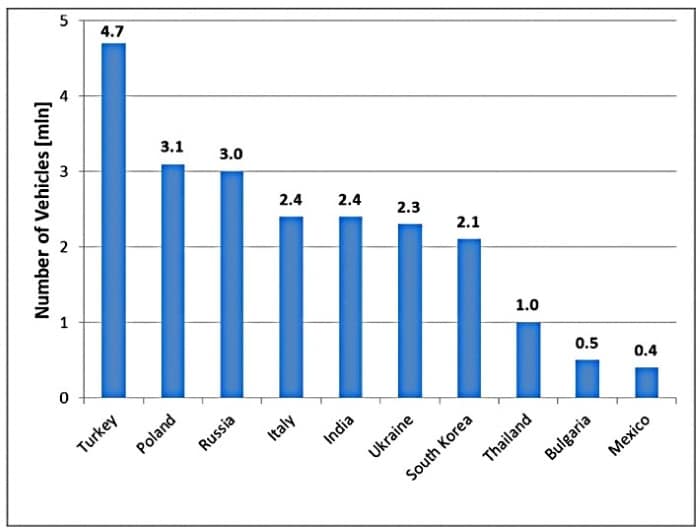
Poland leads the global Autogas industry by fleet count with 3.46 M vehicles.
It is followed by Italy with 2.6 M and Germany with 0.38 M.
At the bottom of the list are Macedonia, Slovenia, and Kazakhstan with 11,960, 11,240 M, and 4,070 M vehicles, respectively [6].
Multiple trends may indicate continued growth in the number of Autogas vehicles entering the market.
This upward trajectory hinges on advancements in LPG technology, changing government policies on emissions, and the potential expansion of the Autogas market across CIS and Eastern European countries.
Autogas Market Penetration by Country
The number of Autogas vehicles per country only tells one side of the story; market penetration rates show the impact.
Several countries feature high shares of LPG vehicles in their total passenger fleet, reflecting the policies, fuel prices, and conversion programs that favour the Autogas industry.
Yet, Autogas use is still concentrated in a small number of countries, with penetration dependent on the strength of government incentive policies.
- Turkey is one of the countries with the highest market penetration rates globally. Approximately one-third of the passenger vehicles in Turkish provinces run on LPG, which is attributed to the long-standing conversion economics and extensive Autogas refuelling network [1].
- Poland and Italy: Driven by favourable tax treatment and retrofit markets, Poland and Italy have seen meaningful national Autogas market penetration in the low teens of the total passenger car market [4].
- South Korea and Japan: Both countries have large fleets of Autogas vehicles, but their market penetration percentages are lower due to their extensive overall vehicle fleets. The adoption of Autogas vehicles is mostly observed in commercial and taxi fleets throughout these nations [2].
- Thailand and Mexico: Notable market penetration is observed in Thailand and Mexico, particularly in areas where taxi and fleet conversions led to early adoption. However, market share is volatile with gasoline and diesel prices [2].
Analysing the Total Cost of Ownership (TCO)
The choice for commercial operators to adopt or retain their Autogas vehicles is driven by a clear factor: economics.
Fuel is responsible for the largest share of operating expenses of a fleet of commercial vehicles, accounting for 40-60% of total running costs [1].
Autogas is typically cheaper than petrol and diesel. It is 40-50% cheaper than petrol and 30-40% cheaper than diesel based on previous market data.
This consistent price advantage of Autogas is linked to rapid payback for conversions and enduring savings for dedicated LPG fleets.
For instance, owning a delivery vehicle that racks up 50,000 km per year in mileage with an average fuel consumption of 10 L/100 km would roughly consume 5,000 L annually. With the current fuel prices:
- Using a petrol-powered vehicle would amount to AUD 10,000 per year, when petrol is priced at AUD 2.00 per litre.
- Using an Autogas-powered vehicle would only amount to AUD 5,500 per year, when Autogas is priced at AUD 1.10 per litre.
This sample scenario illustrates an annual savings of AUD 4,500 when opting for an Autogas vehicle over a petrol or gasoline-powered one.
The typical LPG conversion of a vehicle costs approximately AUD 3,000 to 3,500, which means that the investment pays for itself in under nine months for a highly used car, such as a taxi or delivery vehicle [1][7].
Global Price Comparison: Autogas vs. Petrol vs. Diesel
Fuel price disparity is where Autogas shows its competitiveness.
The following data are the prices of Autogas, petrol, and diesel in Australia:
- Petrol is currently priced at USD1.070 per litre [8]
- Diesel is priced at USD1.096 per litre [9]
- LPG is priced at USD0.409 per litre [10]
The global average price of gasoline is USD1.29 per litre, while diesel has an average global price of USD1.23 per litre, and LPG has a global average price of USD0.75 per litre.
With these current prices, Autogas is a much cheaper option compared to petrol and diesel.
Autogas’s lower price can be linked to LPG production, generated as a by-product of natural gas and oil refining, making supply less affected by the volatility of crude oil.
Emissions Performance and Air Quality Benefits
Autogas is acclaimed as the cleanest conventional fuel in the market, backed by industry test results.
As the race for decarbonization continues, LPG remains a viable, immediate, and scalable pathway to lower emissions.
Vehicles that run on Autogas have lower CO2, NOX, and particulate matter emissions than other conventional fuels like petrol and diesel, positioning LPG further as a practical and readily available solution for cleaner air in cities [1].
| Fuel Type | CO2 (g/km) | NOX (mg/km) | PM2.5 (mg/km) |
| Petrol | 2,300 | 500 | 5 |
| Diesel | 2,650 | 1,200 | 20 |
| Autogas (LPG) | 2,000 | 90 | <1 |
Source:[1][7][11]
Switching from petrol to Autogas can significantly reduce CO2 emissions by almost 15%, NOX emissions by up to 80%, and particulate matter by over 90%.
In regions like Australia, where transportation is responsible for almost 18% of the total greenhouse gas emissions, this conversation serves as a potential reduction, leading to better air quality.
The release of BioLPG, a chemically identical renewable form of LPG produced from waste oils, fats, and biomass, could offer up to an 80% reduction in the CO2 lifecycle compared to other fuel forms [5].
Since BioLPG and LPG are identical, they can be easily used by existing vehicles, and refueling infrastructures can adapt with ease, requiring no modification.
This positions LPG as a cleaner transition fuel and a future-ready solution to reach future decarbonisation goals.
A Pathway to Decarbonisation
As countries continue to push towards achieving their net-zero targets, BioLPG has emerged as one of the most scalable decarbonisation solutions for both the global transport and industrial sectors.
BioLPG is produced from renewable feedstocks, such as waste oils, used cooking oils, animal fats, and other bio-residues.
It is a by-product of renewable diesel and sustainable aviation fuel manufacturing.
It is noteworthy that every tonne of renewable diesel produced could generate roughly 50 kilograms of BioLPG [5].
While produced differently from conventional LPG, they are chemically identical, making them easily applicable to existing Autogas vehicles, supply chains, and refuelling infrastructure without extensive modification.
Unlike other solutions, such as hydrogen or full electrification, BioLPG provides an instant decarbonization solution for sectors that are difficult to convert to electric, particularly high-mileage fleets, taxis, couriers, and forklifts that are mostly reliant on Autogas [12].
Switching from conventional LPG to BioLPG can cut the lifecycle of CO2 emissions by over 80%, depending on where it is produced and how it is produced.
This positions BioLPG as an alternative fuel that offers measurable climate benefits without disrupting the current fuel operations [12].
Beyond the Road: The Dominance of LPG in Materials Handling
While Autogas powers millions of vehicle fleets globally, LPG’s strongest niche in the transport sector today is seen in the industrial and materials handling application, particularly LPG forklifts.
LPG is the fuel source of more than 4 million forklifts globally, making it one of the most used fuel sources in warehouse, logistics, and manufacturing operations [1].
LPG-based fuel dominates this sector due to its high productivity, low emissions, and operational flexibility, especially in indoor and mixed-use environments where diesel or petrol are impractical and considered unsafe for work.
When compared to electric forklifts, those powered by LPG deliver a consistent power output throughout an entire shift, unaffected by battery charge levels or temperature conditions [7].
Given that LPG-powered forklifts are easily refueled using LPG standard cylinders, it steps
away from downtime and infrastructure cost related to electric charging.
LPG-powered forklifts can easily achieve 98% uptime during shifts, while electric forklifts face several hours of downtime per day due to charging.
As such, LPG remains the typical fuel choice for indoor and hybrid operations in Australia, powering around 120,000 forklifts.
With a robust national network of LPG distribution, businesses can operate efficiently across various areas nationwide [7].
Accessing Autogas: Autogas Stations Near Me and Supply
On current trends, global Autogas consumption is projected to reach a peak of just over 31 Mt in 2030 [12].
Besides its market penetration and vehicle volumes, the strength of the Autogas market depends on the accessibility of its refueling infrastructure
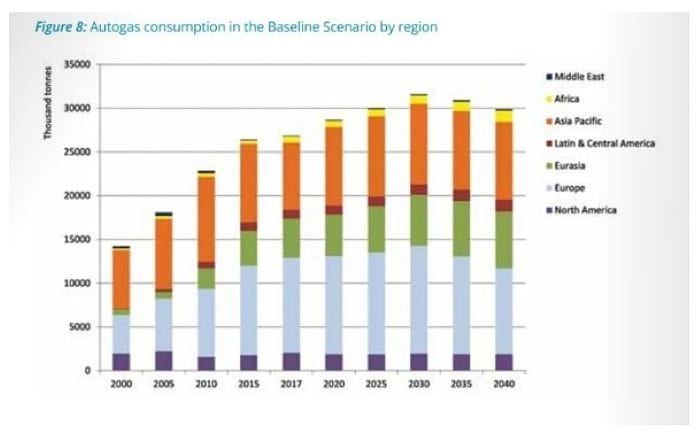
There are over 80,000 Autogas stations around the world, ensuring a stable and convenient supply for both private motorists and commercial fleet operators.
This makes LPG one of the widely available alternative fuels, closely surpassing the global reach of fast-charging stations for electric vehicles [1].
The most extensive Autogas stations nearby are found in Europe and Asia, where Autogas has been crucial in national energy and transport strategies.
Turkey, one of the world’s largest Autogas market leaders, has approximately 11,000 Autogas stations nearby, serving over 4.6 million vehicles in the region [1][12].
South Korea has 4,000 refueling points that support its large fleet of LPG-powered taxis and public transport vehicles.
Countries like Poland, Italy, and Japan also feature heavy refueling networks, each reaching over 2,000 operational Autogas stations around [1][12].
On the other hand, Australia once had one of the highest numbers of Autogas stations per capita, driven by strong adoption in the early 2000s.
While the number of private conversions has heavily declined over the years, there are still thousands of Autogas stations around the country that offer their services to commercial fleets, couriers, and industrial users.
Methodology & Sources
[1] WLPGA – WLPGA-Statistical-Review-2023
[2] WLPGA – Autogas Incentive Policies 2023
[3] Research & Markets – Auto Gas Market Size, Competitors, Trends & Forecast to 2033
[4] Liquid Gas Europe – Common misconceptions about Autogas
[5] WLPGA – BioLPG
[6] ReportLinker – Global Number of Liquefied Petroleum Gas Passenger Cars by Country
[7] EERE – Full Fuel-Cycle Comparison of Forklift Propulsion Systems
[8] Global Petrol Prices – Gasoline Prices
[9] Global Petrol Prices – Diesel Prices
[10] Global Petrol Prices – LPG Prices
[11] ScienceDirect – Comparison of the emission factors of air pollutants from gasoline, CNG,
LPG and diesel fueled vehicles at idle speed
[12] WLPGA – A Global Roadmap for AutoGas

Eric Hahn has over a decade of experience in the LPG industry and has become a key figure in shaping how LPG is marketed and communicated. As the creator of one of the world’s first LPG blogs, Eric has authored over 200 technical posts, helping educate and inform the industry and consumers.
Eric has served on multiple committees for Gas Energy Australia and the World LPG Association (WLPGA), contributing to important discussions and advancements within the global LPG sector. He has presented at WLPGA Annual Conferences, sharing his expertise as a speaker, panellist, and panel chair.
- Food: The Future of Food Starts Here: Paddock to Plate - February 25, 2026
- Bushfires & Gas Bottles: Safety Tips - January 9, 2026
- Sydney Gas Ban Explained: What It Means for New & Existing Homes - December 16, 2025
Steve Reynolds
Technical Consultant
Steve Reynolds is a leading expert in the LPG industry with over 22 years of experience. As part of the national management team at ELGAS, Steve ensures the safe and efficient storage, handling, and transportation of LPG. He serves as the lead investigator for incidents and collaborates with authorities on industry developments.
Steve is a technical advisor to Standards Australia and Gas Energy Australia (GEA), and an active member of the World LPG Association (WLPGA), contributing to global standards and technical reviews. He holds a BSc. (Hons) in Industrial Chemistry from UNSW and has held senior safety and technical roles at ELGAS, making him a trusted authority in LPG safety and standards.