
Global Natural Gas & LNG Statistics (2025 Trends, Forecast & Usage)
While the global energy crisis has receded, geopolitical uncertainty exposes the fragility of the world’s energy security, but LNG is helping solve these problems.
Energy infrastructure also faces risks from extreme weather events.
Too often, the worst impacts are reserved for the poorest societies, regardless of their geographical location.
Even with technological innovation, energy security remains vulnerable to many risks.
Millions of households still lack access to basic energy services such as electricity or safe stoves for cooking.
With all these issues front of mind, it’s critical to reduce reliance on fuels prone to volatility and disruption.
As natural gas only falls behind coal in generating power globally, it is at a tipping point in how it can reliably meet the record-high global energy demands each year.
Let’s crunch the numbers around the global gas market:
- LNG Global Production: Projected global gas production is around 4.1 trillion cubic meters in 2025 [1].
- Top Producers: The United States, Russia, and Iran supply nearly 40% of global output [1].
- LNG Trade Growth: Global natural gas trade reached record volumes of 884.8 billion cubic metres (bcm), driven further by the growth in Asian import demand [2, 5].
- Top LNG Exporters: The US remains the world’s leading LNG exporter, with 11.9 billion cubic feet of natural gas per day in 2024, while Australia and Qatar hover behind [3].
- Consumption Trends: The US also has the highest natural gas consumption, at nearly 22%. This figure almost eclipses Russia and China‘s consumption share, at 11.6% and 10.5%, respectively [4,5].
Why do these trends matter?
This is critical as energy security could be at stake, especially for regions reliant on imports.
Countries with huge gas reserves and extensive infrastructure gain a strategic advantage in the global supply chain.
As LNG demand continues to surge, however, many regions, including Africa and South America, lack the necessary infrastructure to meet this demand.
Read on to learn more from this definitive guide.
What is LNG? LNG Meaning: Liquid Natural Gas or Liquified Natural Gas
What is LNG?
Liquid natural gas (LNG) meaning is natural gas that is cryogenically cooled below -161°C to convert it into a liquid.
Also called LNG, liquefied natural gas must pass through heat exchangers to be converted back into gas before being distributed via pipeline.
Who Holds the World’s Gas? Production and Reserves by Country
The global LNG gas sector is currently shaped by two factors: short-term production capacity and long-term reserve sustainability.
Countries that lead in gas production may not be the same for decades ahead.
Top 10 Natural Gas Producing Countries
Here is a snapshot of the leading natural gas producers in the world, based on the latest available data:
| Rank | Country |
2024 Production (in bcm) |
Growth Rate Per Annum (2014-24) |
| 1 | United States | 1,033.0 | 3.9% |
| 2 | Russia | 629.9 | 0.6% |
| 3 | Iran | 262.9 | 4.1% |
| 4 | China | 248.4 | 6.6% |
| 5 | Canada | 194.2 | 2.0% |
| 6 | Qatar | 179.5 | 0.6% |
| 7 | Australia | 150.1 | 8.7% |
| 8 | Saudi Arabia | 121.5 | 2.2% |
| 9 | Norway | 113.2 | 0.6% |
| 10 | Algeria | 94.7 | 1.7% |
Source: [5]
A data summary in 2024-25 shows global gas production has rebounded by nearly 2%.
Russia, China, and Norway led this rebound.
Meanwhile, the US remains the globe’s top natural gas producer, supplying roughly 25% of global output [6].
Even so, natural gas production volumes can change trajectory due to different factors, such as investment in upstream infrastructure, resource depletion in mature basins, and geopolitical risk.
Top 10 Countries by Proved Natural Gas Reserves
Gas production is essential, but reserves play a significant role in securing long-term supply.
Here are the top nations holding the largest proved gas reserves, as of 2024:
| Region | Country |
Proved Natural Gas Reserves (in billion cubic feet) |
| Europe/Asia | Russia | 1,688 |
| Middle East | Iran | 1,200 |
| Middle East | Qatar | 843 |
| North America | United States | 615 |
| Asia | Turkmenistan | 400 |
| Middle East | Saudi Arabia | 336 |
| Middle East | United Arab Emirates (UAE) | 290 |
| Asia | China | 265 |
| Africa | Nigeria | 209 |
| South America | Venezuela | 195 |
Source: [7]
The top countries seen above account for almost 80% of the global proven gas reserves.
While not on the list, Australia holds significant reserves, with its proved and probable conventional gas reserves at 78,061 petajoules in 2022, while coal seam gas reserves are at 30,859 petajoules.
Despite only having a moderate share of global gas reserves, Australia remains one of the top LNG exporters worldwide.
Who is Using the World’s Gas? Consumption by Country and Sector
The demand for global LNG gas is shaped by two key tensions: the rapid growth of demand in Asia and the structural shift towards renewables in certain parts of Europe and Australia.
That split is important as it determines where LNG tankers flow, which pipelines remain open, or which region faces the largest short-term price and supply risks.
Top 10 Natural Gas Consuming Countries
The world’s LNG gas demand revolves around several large economies worldwide.
The table below shows the rough consumption volumes for the largest demand centres by country in 2024.
| Rank | Country |
2024 Consumption (in bcm) |
Growth Rate Per Annum (2014-24) |
| 1 | United States | 902.2 | 2.2% |
| 2 | Russia | 477 | 1.2% |
| 3 | China | 434.4 | 8.7% |
| 4 | Iran | 245.4 | 3.5% |
| 5 | Canada | 128.5 | 3.1% |
| 6 | Saudi Arabia | 121.5 | 2.2% |
| 7 | Mexico | 100.3 | 2.4% |
| 8 | Japan | 90.9 | -3.1% |
| 9 | Germany | 78.6 | 0.6% |
| 10 | United Arab Emirates | 71.3 | 1.1% |
Source: [5]
Consumption By Sector
LNG is not a single-use product.
It has various uses around the world, mainly for power generation, industrial use, residential or commercial heating and cooking, and transport utilisation.
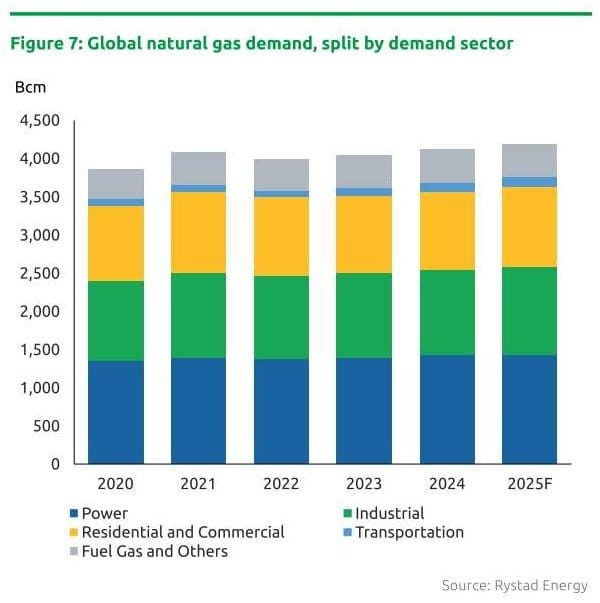
Here is a simple breakdown of how global LNG gas is consumed, split by sector:
Source: [9]
- Power Generation: Roughly 35-40% of global gas consumption is linked to power generation. Gas remains a marginal but flexible source for electricity in most parts of the world [2].
- Industry: Around 30-35% is used for industrial purposes. However, heavy industry that involves the production of steel, chemicals, and fertilisers is a major structural demand source [6].
- Residential and Commercial: Gas is commonly used worldwide for cooking, heating, and hot water. This sector consumes approximately 20-25%, with developing countries and regions in cooler climates having higher consumption shares [2].
- Other Uses: This sector includes gas for transport fuel, LNG plant fuels, and losses. This sector accounts for the least consumption, only around 10% [6].
Liquefied Natural Gas (LNG): The Linchpin of Global Energy Security
As decarbonisation efforts are underway, maintaining stable energy access is essential.
LNG is critical in global energy security, given its flexibility of being shipped, stored, and regasified easily.
Since 2024, LNG’s role in global energy security has been further defined due to geopolitical tensions, European diversification away from Russia’s pipelines, and the continuous increase in Asian demand.
The LNG trade not only connects producers and consumers but also helps close the energy stability gap across nations.
Top 10 LNG Exporters (2024-2025)
While natural gas production remains regional, LNG exports are on a global scale.
This further explains why LNG exportation reshapes energy geopolitics.
The table below ranks the top 10 LNG exporters by volume, which is led by the United States with 88.4 MT of LNG exports.
| Rank | Country | Exports (in MT) |
| 1 | United States | 88.4 |
| 2 | Australia | 81 |
| 3 | Qatar | 77.2 |
| 4 | Russia | 33.5 |
| 5 | Malaysia | 27.7 |
| 6 | Indonesia | 17.6 |
| 7 | Nigeria | 13.8 |
| 8 | Algeria | 11.6 |
| 9 | Oman | 11.3 |
| 10 | Trinidad and Tobago | 9 |
Source: [10]
Top 10 LNG Importers
The demand for LNG continues to grow, especially in Asia due to its rapid industrialisation and in Europe due to its urgent need for energy diversification.
Last year, Asia accounted for over 70% of the global LNG imports, while Europe’s share rose after 2022 because of reduced Russian pipeline imports.
| Rank | Country | Imports (in MT) |
| 1 | China | 78.64 |
| 2 | South Korea | 47.01 |
| 3 | Chinese Taipei | 21.83 |
| 4 | Netherlands | 13.34 |
| 5 | Thailand | 11.8 |
| 6 | Turkey | 9.08 |
| 7 | Kuwait | 7.23 |
| 8 | Belgium | 6.75 |
| 9 | Bangladesh | 5.96 |
| 10 | Poland | 4.88 |
Source: [11]
Major Global LNG Trade Routes
LNG is not just a fuel; it is a logistical network that connects continents.
The world’s LNG connection spans thousands of nautical miles, combined with complex trade flows determined by economics, geopolitics, and weather patterns.
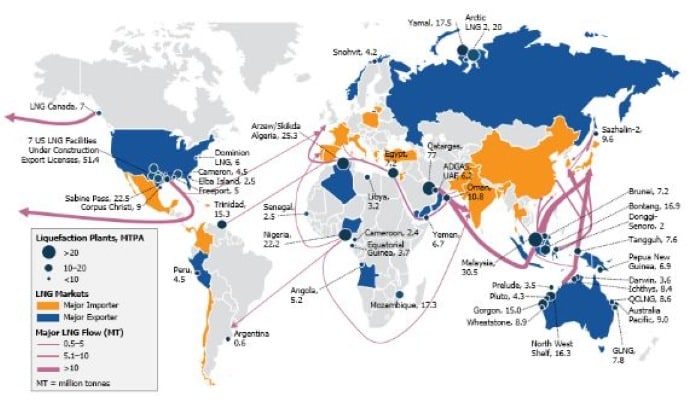
The map below traces the LNG export and import shipping routes:
Source: [12]
The global LNG trade routes consist of four major routes: the U.S. Gulf Coast to Europe and Asia, Australia to the Asia-Pacific, Qatar to Asia and Europe, and Africa (Nigeria, Mozambique) to Europe.
Understanding LNG Gas Price: Henry Hub, TTF, and JKM
The global gas market today continues to operate in a state of dynamic volatility, shaped by various factors, including geopolitical instability, fluctuating LNG demand, and the uneven pace of the energy transition.
Unlike oil that is traded under a unified global benchmark, the LNG gas price remains regionally segmented, responding to local supply and demand balances, weather patterns, and infrastructure capacity.
Due to this fragmentation, three dominant LNG price hubs emerged, namely the Henry Hub in the US, the TTF in Europe, and the JKM in Asia. Each LNG price hub reflects the energy pulse of its region.
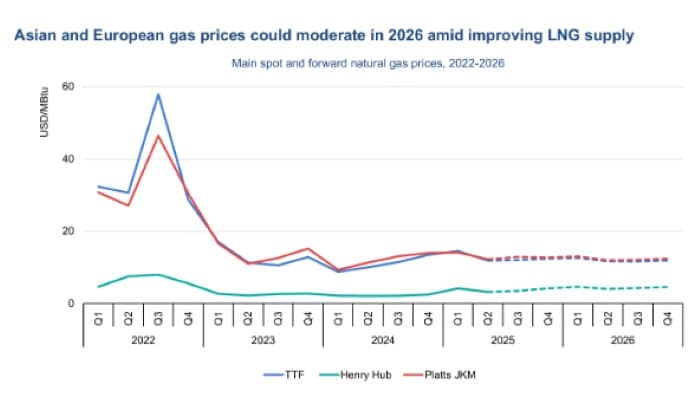
The line graph below shows the Asian and European LNG gas price, with levels expected to moderate by 2026 as LNG supply improves.
Source: [2]
Based on the graph, it can be observed that during the third quarter of 2022, LNG gas price spiked to almost 60 USD/MBtu in the TTF Hub and about 45 to 50 USD/MBtu for the JKM hub, while the Henry Hub only fell between 5 and 10 USD/MBtu.
The European TTF remains the most volatile benchmark globally.
Following the disruption of the Russian gas pipeline in 2022, the region’s decision to import LNG drove TTF to a record high, exceeding USD 60/MMBtu at one instance [2].
Yet, LNG gas price has declined and stabilised since the notable spike, supported by mild winters, demand destruction, and an increase in LNG capacity.
On one side, the lack of infrastructure and competition with Asia retains the elevated volatility.
The JKM LNG index has stabilised to about USD 12 to 13/MMBtu in early 2025.
Demand recovery in Northeast Asia and industrial restarts in China have offset a slowdown in some Southeast Asian markets [2].
For Australia, JKM remains the primary LNG gas price reference for LNG exports, directly connecting the country’s resource sector to Asia’s energy security and decarbonisation pathway.
The Outlook for Natural Gas and LNG to 2030
Natural gas is at a critical point where it is considered the quickest way to cut coal-fired emissions in the power and industry sector, though it still faces challenges due to cheaper renewables, storage, and nascent low-carbon fuels.
It is expected that gas will remain an essential transitional fuel through 2030.
But slower growth, narrower market pockets, and rising policy put pressure on investment decisions and the dynamics of exporting.
Source: [13]
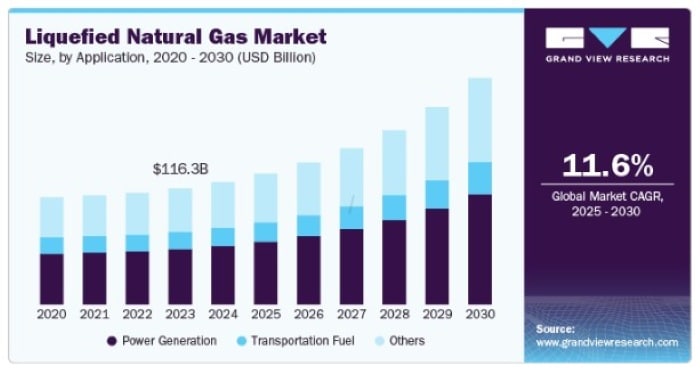
The graph above shows the ten-year LNG gas market forecast, indicating steady growth across sectors such as power generation and transportation.
Gas will continue to grow, but the pace is moderated and may become geographically concentrated [2].
The comparative advantage of LNG gas lies in its flexibility, which provides firming capacity to back variable renewables and can reduce CO2 emissions relative to coal, thereby substituting for high-emission plants.
Forecast models strongly suggest natural gas displacing coal in power mixes across several regions by the late 2020s, specifically in areas where pipeline or LNG access is available [14].
However, this displacement is conditional and relies on various factors like carbon policy, fuel prices, and the pace of storage rollout, which could shorten gas’s window as the preferred transition fuel.
Moreover, three factors impede progress, and those are [2]:
- Decreasing costs for wind, solar and batteries reducing the role for gas in the new generation.
- Industrial electrification and efficiency lower long-run gas intensity.
- Stricter climate policy and investor pressure increase the risk of stranded gas assets.
As a result of these challenges, many new projects face underwriting tests and shorter expected commercial lives unless they embed low-carbon solutions.
On the local scene, Australia is likely to keep supplying approximately 80 Mtpa of LNG through 2030, but export revenues and margins are sensitive to US/Qatar ramp-ups and lower oil-linkage prices.
Local policy choices will regulate whether Australian gas assets remain profitable and aligned with the country’s decarbonisation goals.
What Global Gas Trends Mean for Australia & LNG vs LPG
Australia’s LNG vs LPG energy story remains at a critical juncture, with global demand, export opportunities, and domestic supply pressures all converging.
While the country is known as one of the top global LNG exporters, its domestic gas users on the East Coast remain vulnerable to international market volatility, underscoring the value of locally available, stably priced alternatives, particularly in regional and off-grid communities.
Data from last year revealed that Australia exported over 80 million tonnes of LNG, accounting for nearly 20% of global trade, primarily from Western Australia and the Northern Territory [15].
However, the markets on the East Coast have remained tight on supply and have high prices, as export-linked LNG contracts push the rates closer to international benchmarks.
Industrial and residential consumers are facing ongoing pressure with spot LNG prices reaching $10 to $14 per gigajoule in 2023-24, figures that have never been seen before the LNG export boom.
For LNG vs LPG, LPG, a co-product of domestic natural gas processing and oil refining, offers a reliable and consistent pricing, which moves away from the usual volatility of global LNG contracts.
Australia produces around 3-4 million tonnes of LPG each year, with the majority of this supply going to the domestic market.
Since LPG is portable and does not rely on pipelines for distribution, it remains a key energy source for millions with no access to electrification or natural gas mains.
LPG offers a practical and secure solution that circumvents the volatile and supply problems associated with LNG gas.
From rural heating systems and off-grid hot water to industrial forklifts and commercial cooking, it can power everything [15].
This proves beneficial in certain sectors that demand reliability and control over costs.
With the rollout of renewable LPG, which offers up to 80% lower carbon emissions, this fuel source is crucial to Australia’s goal toward a secure, resilient, and low-carbon energy future.
Methodology & Sources
[1] Global Natural Gas Production in 2025: Trends, Statistics, and Insights
[2] Gas Market Report, Q3-2025
[3] The United States remained the world’s largest liquefied natural gas exporter in 2024
[4] Australian Gas and LNG Tracker
[5] Energy Institute Statistical Review of World Energy 2025
[7] Country Analysis Brief: Iran
[8] Gas Consumption by Country
[9] IGU – Global Gas Report 2025
[10] Top 10 Natural Gas Exporting Countries in the World 2024
[12] LNG Export & Import Shipping Routes
[13] Liquefied Natural Gas Market (2025 – 2030)

Eric Hahn has over a decade of experience in the LPG industry and has become a key figure in shaping how LPG is marketed and communicated. As the creator of one of the world’s first LPG blogs, Eric has authored over 200 technical posts, helping educate and inform the industry and consumers.
Eric has served on multiple committees for Gas Energy Australia and the World LPG Association (WLPGA), contributing to important discussions and advancements within the global LPG sector. He has presented at WLPGA Annual Conferences, sharing his expertise as a speaker, panellist, and panel chair.
- Transportation with LPG: LPG Gas Car & LPG Conversion: How an LPG Gas Car Works – Autogas - March 25, 2026
- Food: The Future of Food Starts Here: Paddock to Plate - February 25, 2026
- Bushfires & Gas Bottles: Safety Tips - January 9, 2026
Steve Reynolds
Technical Consultant
Steve Reynolds is a leading expert in the LPG industry with over 22 years of experience. As part of the national management team at ELGAS, Steve ensures the safe and efficient storage, handling, and transportation of LPG. He serves as the lead investigator for incidents and collaborates with authorities on industry developments.
Steve is a technical advisor to Standards Australia and Gas Energy Australia (GEA), and an active member of the World LPG Association (WLPGA), contributing to global standards and technical reviews. He holds a BSc. (Hons) in Industrial Chemistry from UNSW and has held senior safety and technical roles at ELGAS, making him a trusted authority in LPG safety and standards.