
Australian Petroleum Statistics (2025 Data & Forecast)
Australian Petroleum: The Engine of the Economy (2025 Snapshot)
Petroleum remains an important pillar of Australia’s energy mix and economy.
Australians consume roughly 55 billion litres of petroleum products annually.
It fuels most vehicles and service equipment, ranging from cars and trucks to those used in agriculture, aviation, and industry.
This sector alone contributes an estimated 2-3% of the country’s GDP, highlighting its role as both an economic driver and an essential input to Australians’ daily life.
Presently, the transport sector remains the largest petroleum consumer, powering over 90% of the country’s road freight and passenger vehicles.
Beyond mobility, petroleum is also utilised in industries such as mining, manufacturing, and petrochemicals, vital to Australia’s export competitiveness.
However, the nation’s energy landscape continues to evolve.
While petroleum remains a foundational fuel, complementary fuels like LPG are becoming the go-to choice for most due to their efficiency, accessibility, and lower carbon emissions per unit of energy.
With complementary fuels in the market, the advantages that they bring compared to conventional liquid fuels make them a practical partner in the shift of the energy mix towards a cleaner and more flexible energy use across sectors.
Where Australia’s Oil and Petroleum Products Come From
The supply of petroleum in Australia comes from both local production and extensive imports of refined products.
The dual nature of the country’s petroleum supply has significant implications for both fuel security and efficiency.
Crude Oil and Condensate Production
Australia remains a producer of crude oil, condensate, and LPG, mainly produced on offshore basins such as the North West Shelf, Carnarvon, and Browse.
From 2021 to 2022, local production of crude oil, condensate, and LPG was about 891 petajoules (PJ).
Out of this amount, over 85% were exported, showing how much of the produced goods do not directly serve local consumers.
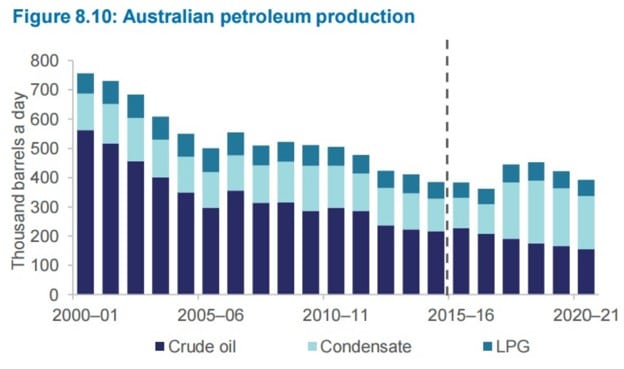
At present, production has been in decline in many established fields, with limited discoveries to replace these production plants.
As shown in the graph below, it can be seen that from 2000 to 2001, petroleum production reached its peak but has gradually declined over the recent years.
Source: [1]
The Shift to Imports: Refineries and Fuel Security
As the country continues to produce crude oil and condensate, the refining sector has decreased over the years.
Several of Australia’s refineries have shut down, reducing domestic capacity to convert oil into petrol, diesel, jet fuel, and other refined products.
With these refineries shutting down, the country has become reliant on imports.
Australia’s energy imports for refined petroleum products and crude oil feedstock are roughly 99% and come from overseas.
With high imports and continuous refinery shutdowns, Australia faces a fuel security challenge, where global supply chain disruptions, shipping delays, or refinery maintenance overseas can significantly impact the price of petroleum in Australia, potentially exacerbating domestic shortages.
However, the country’s policies, such as the Minimum Stockholding Obligation and fuel security reviews, reduce and control the risk of fuel price spikes and shortages.
The ELGAS Perspective: The LPG Advantage in Domestic Production
While fuel security may be an issue, LPG may be the solution to this problem.
Unlike most of Australia’s refined fuel products, a significant portion of the country’s LPG supply is produced domestically, as a by-product of natural gas processing and oil condensate production.
For example, from 2021 to 2022, LPG production rose to around 168 PJ after homegrown condensate and gas production recovered from earlier disruptions (e.g., the COVID-19 pandemic).
With LPG being produced locally, it gives the country a significant edge in energy security, such as:
- Fewer supply chain layers
- Less exposure to import delays
- Resilience for regional and rural areas where petrol and diesel must travel long distances or come from overseas sources
LPG’s local production further makes it a reliable partner as a complementary fuel, together with imported petroleum.
Australian Petroleum Consumption by Sector
Petroleum products remain a vital element in Australia’s energy mix, particularly in its transport and industry sectors.
Despite growing investment in renewables, liquid fuels account for roughly half of the country’s total final energy use, showing their ongoing economic significance.
From 2021 to 2022, petroleum products were able to supply 2,167 PJ of energy for local usage, which translates to almost 45% of total local consumption.
The Transport Sector: The Dominant Consumer
Among the varying consumers of petroleum products, the transport sector is recognised as the largest consumer of the country’s petroleum supply, accounting for more than 70% of total liquid fuel demand.
Here are some important figures to keep in mind:
- Efficiency and adoption of electric vehicles grow, causing a slow decline in demand for petrol, though it’s still a dominant fuel choice for the light vehicle fleet in Australia.
- Diesel, on the other hand, is the fastest-growing petroleum product, which powers freight trucks, mining vehicles, agriculture, and off-road machinery. From 2021 to 2022, diesel consumption was nearly twice that of petrol, with over 925 PJ consumed.
- Following its decline due to the pandemic, jet fuel demand has rebounded. It was able to reach 245 PJ from 2021 to 2022, with further growth expected as the aviation activity continues.
Even so, these figures revealed that petroleum continues to keep goods and people moving across Australia, specifically in freight and aviation, where alternatives remain limited.
Industrial, Commercial, and Agricultural Sectors
Outside of the transport sector, petroleum also plays a vital role in industrial and agricultural operations.
In these sectors, diesel is the primary source of energy utilised for various activities such as:
- Powering mining equipment and heavy machinery in resource extraction projects.
- Agricultural machinery, including tractors, harvesters, and irrigation pumps.
- Backup power generation for remote industries and commercial facilities.
From 2021 to 2022, data suggest that industrial, commercial, and agricultural uses of petroleum accounted for about 400 PJ, with diesel eclipsing the fuel chart in these sectors.
Residential Sector
Usage of petroleum products is limited in Australian households.
Some older or regional homes in the country may remain reliant on heating oil or kerosene for space heating, water heating, or cooking, which are common in areas without access to natural gas or reliable electricity.
In fact, residential petroleum consumption is less than 1% of the total demand.
Other energy sources mostly fill in this demand, like LPG, which is considered a more practical and cleaner alternative.
Choosing the Right Fuel: A Head-to-Head Analysis
Australia’s transportation industry demonstrates that petroleum-based fuels are leading the way, yet LPG stands out as an efficient choice for cost-effective and environmentally friendly operations.
The number of vehicles running on Autogas has decreased with time, yet businesses still find it useful for their fleets, taxis, and forklift operations.
This analysis presents a detailed examination of three fuel types, comparing their operational advantages, economic expenses, and environmental impacts.
Cost Comparison: The Autogas Price Advantage
For over a decade, Autogas (or LPG) has been the cheapest road fuel in the country, costing less than half the price of petrol in the market and about 30% to 40% less than diesel.
Source: [3]
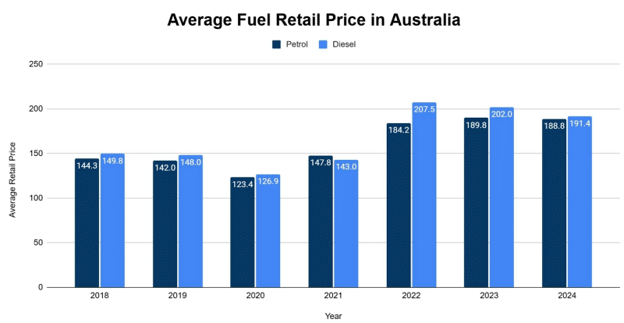
The graph above shows the average fuel retail price in Australia from 2018 to 2024. It indicates that the fuel retail price had the lowest average in 2020, which can be correlated to the pandemic.
However, it had increased from 2022 onwards.
Source: [4]
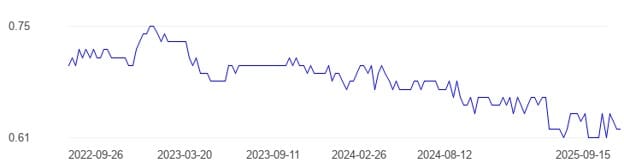
On the other hand, Australia’s LPG prices tell a different story from 2022 to 2025.
The graph above shows a general downward trend over three years, despite an initial peak and several periods of volatility.
Emissions Comparison: The Cleaner Choice
Autogas also delivers measurable environmental benefits, as it produces fewer harmful pollutants like nitrogen oxides and particulates, reducing greenhouse gas emissions compared to petrol and diesel usage.
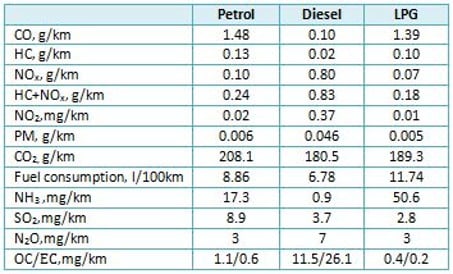
The table below shows the comparison of gas emissions among petrol, diesel, and Autogas.
Source: [5]
The lower NOx and particulate emissions from LPG are valuable in urban environments, which aid in reducing air pollution and improving health risks associated with diesel exhaust.
For Business Fleets: Why LPG is the Superior Choice
LPG remains a practical, cost-effective fuel, making it a superior choice for commercial operators of business fleets.
- Lower running costs: Consistently cheaper fuel costs and reduced wear on engines.
- Cleaner burn, lower maintenance: LPG combustion produces less carbon buildup than conventional fuel forms, extending your engine’s life and lowering servicing costs.
- Improved workplace air quality: Indoor-use vehicles, such as forklifts and other vehicles that operate in enclosed spaces, achieve better air quality through reduced emissions, which safeguards workers from dangerous diesel fumes.
- Fuel security: With strong local production of LPG in the country, it provides a much more stable supply chain compared to imported petrol and diesel.
These features explain why LPG continues to play a vital role in the taxi, courier, and warehouse logistics industries.
While electric vehicles are gradually emerging, Autogas remains a cost-efficient bridge fuel for those looking to balance budgets with sustainability.
The Versatility Advantage: LPG for Business and Home
Petroleum fuels, such as petrol and diesel, dominate the country’s transport sector.
On the other side, LPG’s flexibility extends beyond the road, even making an impact in stationary energy applications, a critical energy source in regional and off-grid communities.
Replacing Diesel for Power and Heat
Diesel traditionally powers generators and burners for electricity and process heat.
However, LPG provides a cleaner and more efficient alternative.
Gas Energy Australia revealed that LPG releases 20% less CO₂ emissions than diesel fuel and produces nearly no particulate matter [6], thus becoming a desirable choice for environmental improvement and worker health protection.
For homes that do not have access to electricity, LPG generators function with few maintenance needs and a much quieter function than diesel units that suffer from soot buildup and fuel degradation.
This is exactly why industries such as agriculture, mining, and food services still adopt LPG for crop drying, heating, and cooking, thanks to its portability, reliability, and reduced local pollution.
The Clear Winner for Home Energy
In Australian households, LPG remains the modern standard for off-grid living, surpassing the limited use of heating oil in older and regional homes where electricity is not available.
Presently, over 2.6 million Australian households rely on LPG for hot water, cooking, and space heating, specifically in areas not serviced by natural gas networks [7].
Unlike heating oil, which is bulky and less efficient, LPG is delivered in portable cylinders or bulk tanks that are scalable to your household’s needs.
It also integrated easily with modern appliances, providing instant heat, clean combustion, and lower emissions compared to other liquid fuel alternatives.
Those beyond the gas grid, LPG offers reliability and flexibility, ensuring energy security even without the high infrastructure costs of pipeline connections.
This places LPG as not only a bridge fuel for the energy transition but also a practical, everyday energy solution for millions of households across Australia.
The Outlook for Australia’s Energy Mix
The future of Australia’s energy mix is fueled by balancing carbonisation goals with the practical realities of transport, industry, and household demand.
While petroleum remains an essential element in certain factors, other fuel forms, such as LPG, emerge as both a go-to fuel and a transition choice for a future cleaner energy mix.
The Long-Term Role of Petroleum
Despite changes in global energy utilisation, petroleum products like diesel, petrol, and jet fuel remain key players in the transport and industry sectors.
Based on DCCEEW’s data, liquid fuels remain responsible for over 50% of the total energy consumption in the country [8], and their energy density makes them difficult to replace in transport and resource sectors that use heavy transport, aviation, and mining.
While electrification and hydrogen efforts are progressing locally, the full transition to these energy systems will take a considerable amount of time, ensuring a continued yet steadily declining role for petroleum.
LPG: The Smart Transition Fuel for Today and Tomorrow
LPG offers a better option than other conventional fuel types, as it has lower emissions and is a widely available alternative that cuts greenhouse gas emissions by up to 20% [7].
Unlike other emerging technologies for a smarter energy system that require new infrastructure, LPG utilises an established supply chain of production, storage, and distribution.
With LPG’s usage of existing infrastructure, it’s cost-effective for households and businesses to lower emissions immediately, particularly in regional and off-grid areas that do not have access to natural gas pipelines.
The Path to Net Zero: Renewable LPG (rLPG)
Looking beyond petroleum products, renewable LPG (or rLPG) represents the sector’s biggest innovation.
It is produced from bio-based feedstocks, renewable dimethyl ether, and synthetic pathways.
rLPG is chemically identical to conventional LPG, making its application for storage, transportation, and appliances seamless and needing no modification.
By 2040, rLPG is expected to supply roughly 50% of the country’s LPG demand [9], offering a drop-in, scalable solution that supports net-zero targets without creating stranded assets.
For Australia, this places LPG as more than just a bridge fuel.
It is a reliable long-term partner in transitioning to clean energy, which is anchored in today’s infrastructure and prepared to evolve in the future’s renewables.
Data Sources & References
- [1] Department of Industry, Innovation, and Science – Australian crude oil production
- [2] ResearchGate – Australian net energy consumption (%) sector wise
- [3] Road Genius – Fuel Cost Statistics in Australia
- [4] Global Petrol Prices – Australia LPG prices
- [5] International Energy Agency – Liquefied petroleum gas, LPG
- [6] Gas Energy Australia – Safeguard Mechanism – Best Practice Emissions Intensities Update
- [7] Gas Energy Australia – Annual Report 23-24
- [8] DCCEEW – Australian Petroleum Statistics 2024 | energy.gov.au
- [9] Frontier Economics – Pathway to zero emissions for LPG | Gas Energy Networks National Forum

Eric Hahn has over a decade of experience in the LPG industry and has become a key figure in shaping how LPG is marketed and communicated. As the creator of one of the world’s first LPG blogs, Eric has authored over 200 technical posts, helping educate and inform the industry and consumers.
Eric has served on multiple committees for Gas Energy Australia and the World LPG Association (WLPGA), contributing to important discussions and advancements within the global LPG sector. He has presented at WLPGA Annual Conferences, sharing his expertise as a speaker, panellist, and panel chair.
- Automated 45kg Gas Bottle Exchange in Ocean Shores - May 11, 2026
- Wet Season Gas Safety: Mullumbimby Home Guide – ELGAS - May 11, 2026
- 45kg LPG Gas Bottles For Your Byron Hinterland Property - May 11, 2026
Steve Reynolds
Technical Consultant
Steve Reynolds is a leading expert in the LPG industry with over 22 years of experience. As part of the national management team at ELGAS, Steve ensures the safe and efficient storage, handling, and transportation of LPG. He serves as the lead investigator for incidents and collaborates with authorities on industry developments.
Steve is a technical advisor to Standards Australia and Gas Energy Australia (GEA), and an active member of the World LPG Association (WLPGA), contributing to global standards and technical reviews. He holds a BSc. (Hons) in Industrial Chemistry from UNSW and has held senior safety and technical roles at ELGAS, making him a trusted authority in LPG safety and standards.