

LPG Statistics Australia
The State of LPG in Australia
Liquefied Petroleum Gas (LPG) is a high-density fuel, with varying mixtures of propane and butane gases.
It’s relatively easy to liquefy under mild pressurisation, typically used for space heating, water heating, process heat, and even automobiles.
Its unmatched energy storage capability far surpasses most market options.
A standard residential LPG setup (2 x 45 kg tanks) could hold enough energy to rival the output of over 42 Tesla Powerwall 3 units at around one-tenth the cost.
This exceptional storage capacity, combined with its portability, makes LPG invaluable for energy security and emergency resilience, specifically in areas where power remains unreliable or unavailable.
As one of the most versatile and essential energy resources, the Australian LPG industry delivers key benefits [1]:
- Brings over AU$5 billion to the country’s economy and supports over 20,500 full-time jobs
- Safely supplies an estimated 43 petajoules (PJ) of LPG per year, while exporting a much larger amount of 120 PJ
- Supports about 30% of Australian households, especially in regional and remote areas, which are highly reliant on LPG for their everyday vital needs
- Serves roughly 130,000 commercial and industrial businesses, including agricultural and construction applications
- Produces around 30% fewer greenhouse gas emissions than coal and 14% fewer than diesel, which is crucial to the country’s net-zero emission goals
These headline figures set the stage for an in-depth exploration of the LPG landscape, covering every detail, from consumption trends and supply dynamics to usage, pricing patterns, safety standards, and market forecasts.
This report intends to equip industry leaders, policymakers, and stakeholders with the insights required to navigate the industry in Australia’s evolving energy transition.
Australia’s LPG Supply and Demand Overview
Currently, the demand for LPG remains steady but modest in the energy market mix.
Based on 2023 data [2], the country consumed around 20.8 thousand barrels of LPG per day, which is lower compared to the previous year’s 22.97 kbpd in 2022 and is significantly below the historical average of 48.8 kbpd.
With this decreasing usage of LPG, both oil and LPG represent a sustained but narrowing slice of the total primary energy supply in Australia.
This section dives deeper into the mechanics that are driving the supply and demand of the country’s LPG, particularly how many Aussies rely on it and where it comes from.
Total Annual LPG Consumption (Petajoules)
Australia’s current annual LPG consumption snapshot is estimated to be around 43 PJ per year domestically, with the industry also exporting about 120 PJ [3].
This shows that the LPG market in Australia has a greater export volume than its local consumption.
Domestic Production vs Imports
The source of Australia’s LPG comes from two sources: domestic production and imports.
Australia’s domestic production of LPG comes from its natural gas processing and refinery operations, while its imports come from specific countries.
While detailed data regarding the percentage of domestically produced and imported LPG is not publicly available across recent years, the mix of local refinery production and gas-plant co-production maintains the country’s supply.
The country’s local supply is also periodically supplemented with imports when local demand increases or when infrastructure experiences any constraints.
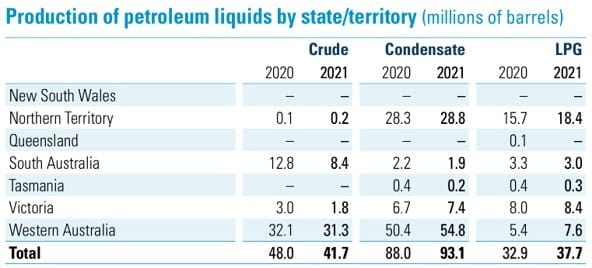
Source: [4]
The figure above shows the different volumes of petroleum liquids produced by the state or territory in Australia.
Overall, the country produced 32.9 million barrels in 2020 and 37.7 million barrels in 2021, highlighting the country’s great capability in producing LPG for domestic use and export to the market.
Key LPG Production Sources
There are two key production sources of LPG in the country: oil refining and natural gas processing.
- Oil refining through shelled-off LPG during the processing of crude oils.
- Natural gas processing is the process of extracting propane and butane during gas conditioning.
These two sources have historically contributed to the supply of LPG in Australia, providing relative energy security and localisation advantages.
How Australian Homes Use LPG
LPG remains a staple in Australian homes, especially those who are beyond the urban gas grid.
National data suggest that an estimated over 2 million Aussie households use LPG indoors every day for cooking, hot water, or heating.
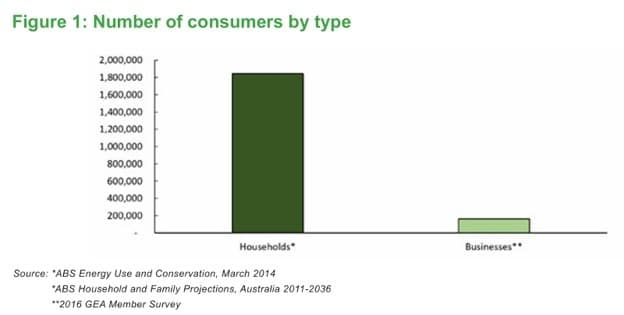
Source: [5]
Further, it’s noteworthy that roughly 1 million regional households in Australia are reliant on bottled LPG, compared to over 800,000 in capital cities.
Number of Australian Households Using LPG
Industry breakdowns provide a practical state snapshot of the number of Aussie households that use LPG [6]:
- Queensland: ~607,000
- New South Wales: ~532,000
- Victoria: ~356,600
- Western Australia: ~327,000
- South Australia: ~153,700
- Tasmania: ~29,000
- Northern Territory: ~20,700
In total, these counts per state are estimated to be around 2 million households.
Regional concentrations, such as Queensland and NSW, reflect areas with lower mains coverage, having a stronger bottled-LPG market than others.
Primary Uses of LPG in the Home
LPG has three specific uses in Australian homes, according to statistical data, which include home and water heating, as well as cooking [6].
Yet, it’s important to remember that LPG is not only utilised at home but is also used by various industries.
Its extensive applications span across critical sectors, particularly in manufacturing, construction, commercial and institutional energy.
LPG vs. Natural Gas and Electricity in Homes
Statistical data revealed that over 15% of Australian homes are reliant on bottled LPG, while about 50% are connected to mains natural gas, which is most observable in major cities.
The remaining percentage of Australian households relies on other energy sources such as electricity.
Proportion of households by state with LPG
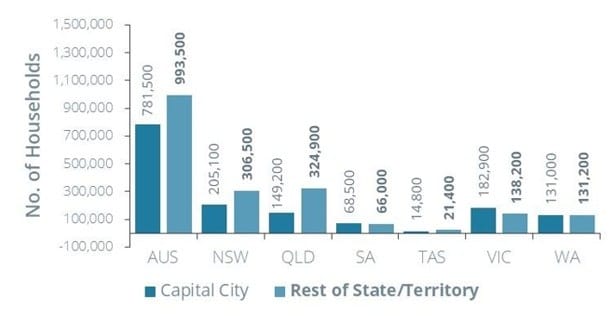
Source: [6]
Moreover, various regional areas in Australia are more dependent on LPG, where piped gas remains unavailable.
Average Household LPG Consumption
Gas consumption varies based on different considerations, such as state, season, climate zone, and household size.
Based on previous average gas consumption data, Victoria has the highest gas consumption across all seasons and household sizes, while Queensland spends the least.
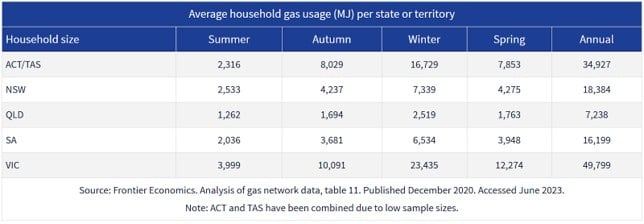
Source: [7]
While the national average on LPG consumption varies, the typical Australian household uses between 30 and 40 gigajoules (GJ/pa) per year, which is comparable to mid-range residential gas usage benchmarks [8].
The Role of LPG in Australian Businesses and Industry
LPG’s versatility spans beyond residential use.
It provides energy access for industries within manufacturing, commercial, agricultural, construction, and disaster response and recovery.
For most other industries, LPG is a vital input, typically used in power generation, mining, metal processing, food production, and industrial equipment such as ovens and furnaces.
Total Commercial LPG Consumption
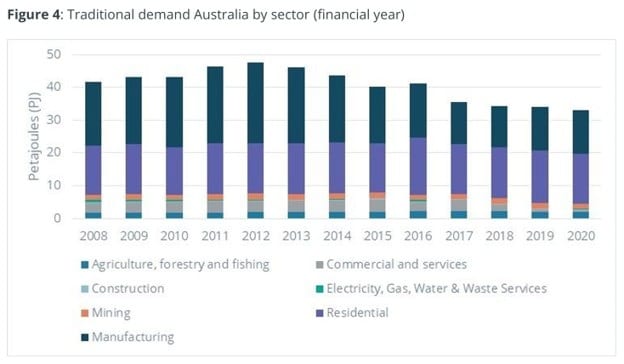
Commercial and industrial use of LPG has remained stable in recent years.
This can be attributed to its support from other sectors, such as food service, agribusiness, and light manufacturing.
Source: [6]
The graph above illustrates the high demand for LPG by sector in Australia since 2008, showing stability throughout the years and the support from other sectors, primarily residential and manufacturing.
The year with the greatest demand was 2012, while 2020 appears to be the least demanding year, but it remains stable and modest.
On the 2023-24 data points, oil, including crude, LPG, and refined products, accounted for the largest share of the country’s energy consumption (41%), with coal and oil both only at 25% [9].
Key Commercial Applications
LPG has various applications both in business and industry.
Below are key commercial applications of LPG:
Forklifts
Many logistics and warehousing operations depend on LPG-powered forklifts for indoor use because of their low-emissions production.
Industrial and Hospitality Heating
LPG is commonly used in restaurants, cafes, hospitals, and resorts for consistent, high-output heating, especially during the winter season when LPG usage is the highest due to cold temperatures.
Agricultural Use
LPG-powered equipment is deployed for crop drying, greenhouse temperature regulation, and water heating.
LPG as a Business Continuity Fuel
The reliability of LPG makes it a popular backup energy source when a grid outage occurs.
It’s commonly used in critical commercial operations where downtime is not an option.
As an energy portable access, there are more than 20 million cylinders serving households, businesses, community groups, and worksites Australia-wide.
Autogas in Australia: The Current Landscape
Autogas, as a type of LPG, is an alternative fuel choice for vehicles in Australia.
Autogas has had a stable base in the transport sector.
However, detailed national figures are scarce; it is still a niche yet valuable fueling option for dual-fuel vehicles that seek cost efficiency.
Total Number of Autogas Vehicles
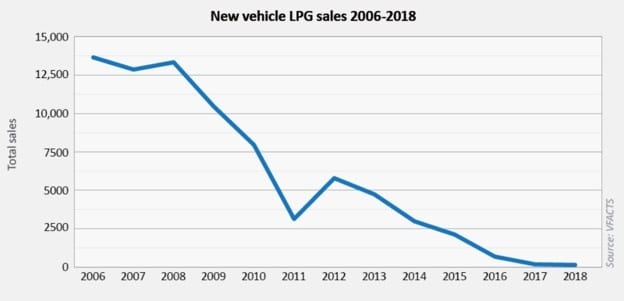
The total number of Autogas cards in Australia has declined significantly, from roughly 500,000 in 2013 to just 200,000 presently, a drop of almost 60% over the last decade [10].
Sources: [10]
The graph above shows the decline of new vehicle LPG sales from 2006 to 2018, strongly indicating the plummeting Autogas vehicles in the country.
This decline can be attributed to shifting consumer preferences, the cessation of local Autogas vehicle production, and inadequate infrastructure support.
Since the release of petrol-hybrid vehicles, there are fewer refueling stations, forcing most consumers to switch from LPG vehicles.
Autogas Consumption Volume
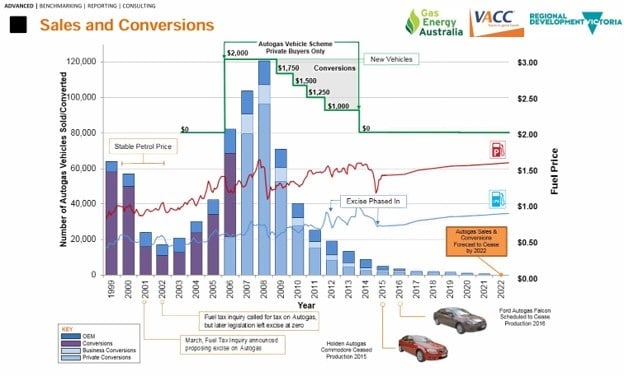
The decrease in registered Autogas vehicles points to proportionally lower demand.
Both fuel retailers and LPG industry stakeholders have acknowledged the decline in Autogas vehicles in the market in recent years, which is correlated to the shrinking vehicle base.
Source: [11]
Autogas vehicle sales declined for both OEM and converted, with the impact felt across the entire sector.
Though the exact annual consumption data is limited, this lower vehicle base reflects the Autogas consumption volume.
The Autogas Price Advantage
Historically, Autogas has provided great cost savings.
Autogas in Australia used to cost less than half the current price of petrol, making it a popular choice among consumers who are looking to save money.
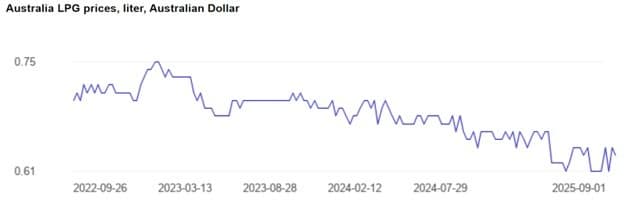
More recently, LPG prices have fluctuated between AUD 0.61 and 0.75 per litre, averaging about AUD 0.68 per litre, compared to petrol that averages at about AUD 1.79 per litre, maintaining a clear cost advantage.
However, the decreasing number of vehicles and shrinking refueling infrastructure are limiting its viability.
Understanding LPG Pricing & Market Trends in Australia
From international benchmarks to logistics costs, LPG pricing can be influenced by various factors.
Its wholesale pricing has experienced moderate changes over the last decade, and identifying these factors can help in understanding how they affect the changes in LPG pricing.
Historical LPG Price Trends
In previous years, LPG pricing in Australia has moderately changed due to various factors.
The current price of LPG is $0.63, a 0.05 decrease from the previous year.
Source: [12]
The graph shown above is the price trend of LPG in Australia from 2022 to 2025.
The trendline highlights a surge in price in early 2023, which also declined later on.
Observable flat lines along the graph indicate that the government fixed the price of LPG.
With LPG’s current price point, 0.63AUD, it still offers a huge cost advantage over petrol and diesel.
Factors Influencing LPG Prices
LPG prices typically fluctuate due to international benchmarks, currency movements, transport and distribution costs, and domestic versus export balance [13].
International Benchmarks
The Saudi Aramco Contract Price, or Saudi CP, is the main reference point.
It sets wholesale levels for the Asia-Pacific region, which also influences Australian import parity.
Currency Movements
Not only are fuel prices affected by fluctuations in exchange rates, but LPG prices are as well.
Fluctuations in the AUD/USD exchange rate impact landed LPG costs.
The weaker the Australian dollar is, the higher the retail price.
Transport and Distribution Costs
Transporting and distributing LPG across Australia, especially to regional and remote markets, is also a huge driver of LPG’s price hikes.
This also includes freight shipping that accounts for up to 20% of the delivered cost.
Domestic versus Export Balance
With the number of LPG exports greater than local demand, Australian LPG pricing is greatly exposed to global demand conditions and shipping markets.
LPG remains one of the most cost-competitive fuels in Australia.
Yet, its pricing will always be linked to global benchmarks, making volatility management a key factor for both its suppliers and consumers.
The Environmental and Safety Credentials of LPG
As Australia continues its energy transition, LPG is on the safer and cleaner side than many traditional fossil fuels.
With features such as a lower emissions profile and a robust safety record, it remains secure and reliable for a wider scale of utilisation in different sectors.
LPG Emissions Data
When compared to other conventional fuels, LPG offers a clear environmental benefit.
On a combustion basis, LPG produces around 60 to 61 kg CO2-e per GJ, which is significantly lower than 67.6 kg CO2-e/GJ and 90 to 100 kg CO2-e/GJ from other conventional fuels [14].
This lower emissions profile makes LPG one of the cleanest-burning fossil fuels available on the market, an essential part of Australia’s energy mix.
LPG’s Role in a Cleaner Energy Mix
With its superior features, such as storable, portable, and reliable, LPG provides a flexible bridge in Australia’s energy transition.
In regional and off-grid areas, LPG has already reduced reliance on higher-carbon fuels like diesel or wood.
On the other hand, in urban settings, it complements renewable electricity well, covering energy needs where direct electrification is not yet practical.
Looking into the future, renewable LPG (e.g., bioLPG, rLPG, & eLPG) will enable the same infrastructure, cylinders, appliances, and distribution networks to deliver progressively lower-carbon energy without disruption [15].
This further cements LPG’s role as a partner to renewables rather than just another competitor.
LPG Safety Record
Safety is one of the main features of the LPG sector in Australia.
The fuel has a long and proven safety record, regulated by strict national frameworks, like AS/NZS 1596, and overseen by state regulators and agencies, including Energy Safe Victoria, among others.
With decades of usage in different sectors, residential and vehicles, LPG has demonstrated that it is both safe and reliable when properly handled with established guidelines and procedures.
The Future of LPG in Australia: Forecast to 2030 and Beyond
Across multiple sectors in Australia, LPG demand is projected to remain stable for the succeeding years, with the possibility of modest growth in niche areas, such as remote heating, commercial kitchens, and backup generation.
A stronger increase in demand can be expected in parts of rural Australia where Aussies are transitioning towards off-grid homes to avoid volatile electricity prices.
Expert forecasts also indicate that the industry is expected to grow by 5.2% over the next decade (2025-2034).
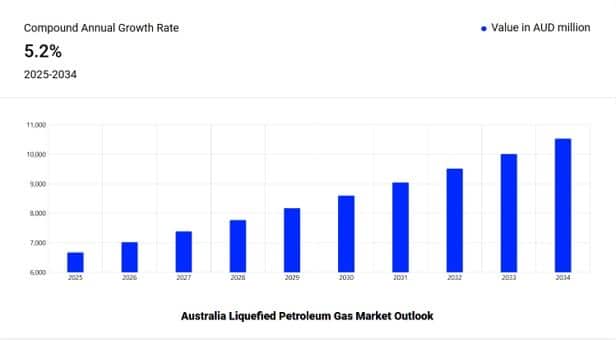
Source: [14]
Projected Demand Across Sectors
Residential and Commercial
Regional demand will remain steady as LPG remains the practical option for off-grid homes.
However, urban use may slightly decrease under electrification policies like Victoria’s gas-to-electric shift [16].
Industrial and Agriculture
As LPG remains a critical component in industry and agricultural processes, usage is expected to remain steady.
Processes where LPG is essential include heat, crop drying, and hospitality, where alternative measures are limited.
Autogas (Transport)
Despite the price advantage of LPG, this sector is declining, especially with the release of electric vehicles and hybrids and the decline in Autogas refueling sites.
Supply and Renewable Pivot
Possible growth is expected and reliant on the arrival of renewable LPG, also known as bioLPG and other types, which is set to arrive around 2025 to 2026.
Forecasts show that this arrival will blend into the market through the 2030s, replacing conventional LPG without disrupting existing infrastructure.
The Rise of Renewable LPG (rLPG/BioLPG)
Renewable LPG, also known as bioLPG, is an emerging low-carbon alternative to conventional LPG.
It has the potential to reduce lifecycle emissions and future-proof the LPG sectors as Australia aims for a net-zero goal.
ELGAS’s Outlook on the LPG Market
ELGAS asserts from current and projected future data that LPG will stay as an essential and strategic product in the country’s energy mix through 2030 and even in the succeeding years.
Its versatility, reliability, and lower emissions of its renewable forms solidify it in Australia’s sustainable energy future.
Data Sources & References
- [1] Gas Energy Australia – Annual Report 2024-2025
- [2] The Global Economy – Australia: LPG Consumption
- [3] Australian Bureau of Statistics – Energy Account, Australia
- [4] APPEA – Key Statistics 2022
- [5] Gas Energy Australia – The Australian LPG Industry September 2017
- [6] Frontier Economics – Pathway to Zero Emissions for LPG
- [7] Compare the Market – Gas Consumption in Australia
- [8] Climate News Australia – Australia’s Gas Supply: An Overview
- [9] DCCEEW – Australian Energy Statistics – Update Report 2025 2025
- [10] GoAuto – Market Insight: The Rise and Fall of LPG
- [11] WLPGA Autogas Track – The Future of the Autogas Vehicle Market
- [12] Global Petrol Prices – Australia LPG Prices
- [13] ACCC – Report on the Australian Petroleum Market
- [14] Expert Market Research – Australia Liquefied Petroleum Gas Market Size, Share, Growth Analysis Report and Forecast Trends 2025-2034
- [15] Australian Gas Infrastructure Group – Gas Vision 2050
- [16] Herald Sun – Cooking, heating, hot water: Vic’s ever-changing gas rules explained

Eric Hahn has over a decade of experience in the LPG industry and has become a key figure in shaping how LPG is marketed and communicated. As the creator of one of the world’s first LPG blogs, Eric has authored over 200 technical posts, helping educate and inform the industry and consumers.
Eric has served on multiple committees for Gas Energy Australia and the World LPG Association (WLPGA), contributing to important discussions and advancements within the global LPG sector. He has presented at WLPGA Annual Conferences, sharing his expertise as a speaker, panellist, and panel chair.
- Winter on the Manning River: Beautiful but Brisk - July 6, 2026
- The Harsh Reality of June in the Snowy Mountains - July 6, 2026
- The True Cost of a Freezing Guest in the Snowy Mountains - July 6, 2026
Steve Reynolds
Technical Consultant
Steve Reynolds is a leading expert in the LPG industry with over 22 years of experience. As part of the national management team at ELGAS, Steve ensures the safe and efficient storage, handling, and transportation of LPG. He serves as the lead investigator for incidents and collaborates with authorities on industry developments.
Steve is a technical advisor to Standards Australia and Gas Energy Australia (GEA), and an active member of the World LPG Association (WLPGA), contributing to global standards and technical reviews. He holds a BSc. (Hons) in Industrial Chemistry from UNSW and has held senior safety and technical roles at ELGAS, making him a trusted authority in LPG safety and standards.