
The Global State of LPG in 2025
Global LPG Market: 2025 Snapshot
LPG remains a core part of the global energy mix, serving households, industries, and petrochemical plants alike.
In the previous year, total LPG consumption reached a record high of 347 million tonnes, an annual average growth of 3.3% over the past decade.
More than one-third of global LPG use is led by China at 96 million tonnes, followed by India at 39 million tonnes, marking that the highest demand falls within the Asia-Pacific region [1].
China’s consumption is linked to petrochemicals, while India is tied to residential programs across rural households.
On a global scale, residential and commercial use account for the largest demand for LPG, at 44% [2].
Yet, the petrochemical industry is trailing behind as the fastest-growing consumer of LPG, especially in Asia and the Middle East, where new processing capacity continues to surface online [3].
The global LPG market is currently valued at roughly USD 200 billion.
By 2035, this is expected to reach USD 260 billion.
With its residential and commercial importance, LPG remains an essential, flexible fuel source in the world’s evolving energy system.
Global LPG Production and Consumption Trends
The LPG market is expanding steadily on a global scale, driven by intensifying residential demand in emerging economies and increased petrochemical feedstock use in Asia and the Middle East.
In 2024, global LPG consumption peaked at 347 million tonnes, representing an average 3.3% CAGR since 2013.
The Asia-Pacific region covers almost half of the world’s LPG demand, while the United States leads the production and export numbers, reshaping the trade flow into Asia [4].
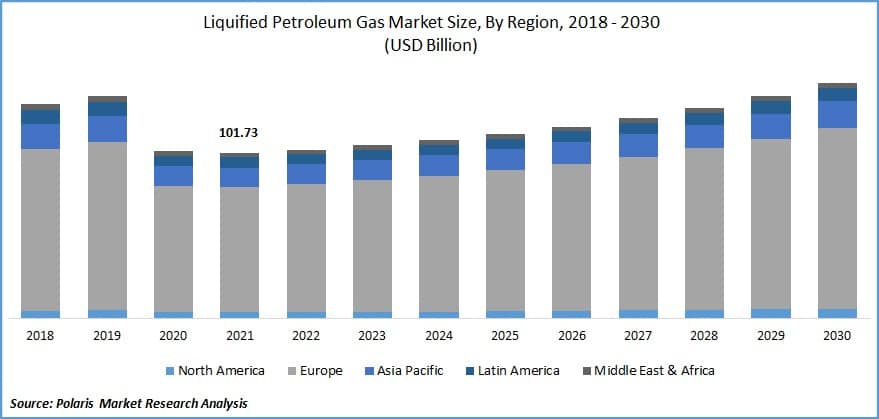
Total Global LPG Consumption (Million Tonnes)
From approximately 250 Mt in 2014 to 347 Mt in 2024, LPG has experienced extensive and consistent expansion, despite slowdowns in 2020 due to the pandemic.
China and India continue to be the largest contributors, with widespread adoption of LPG as a clean solution for household cooking and heating.
The demand has also increased in petrochemicals, where propane and butane are identified as key products.
Source: [5]
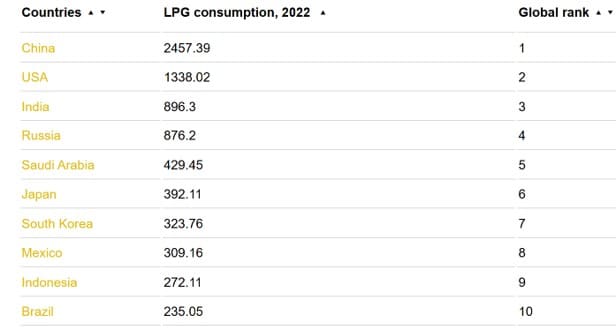
Top 10 LPG-Consuming Countries
Based on the global top LPG consumers, China leads the rankings with 2457.39 (thousand barrels per day), followed by the United States with 1338.02 and India with 896.3.
Among the ten countries, Brazil has the least consumption of LPG, with only 235.05 thousand barrels per day.
Source: [6]
Upon closer examination, most countries included in the top LPG consumers list are from the Asia-Pacific region, confirming both its high demand and consumption of the product.
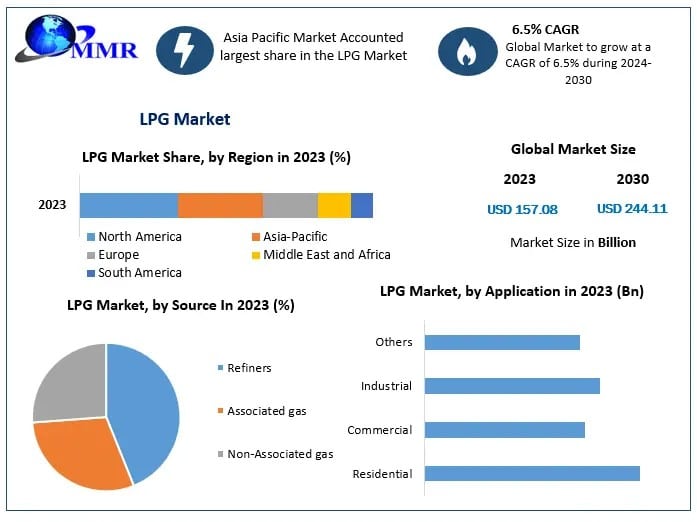
Global LPG Production Sources
From a global perspective, 62% of the LPG supply originates from natural gas processing, while the remaining 38% comes from oil refining [7].
The share of gas-derived LPG has increased over the past decade, with the majority of this growth attributed to the shale gas boom in the United States and the further expansion of natural gas production in Qatar and Saudi Arabia [8].
Source: [9]
Top 5 LPG Producing Countries
The leading producers of LPG in the previous year were [10]:
- United States: The United States is considered the world’s largest LPG-producing country, accounting for more than 25% of the global supply. It also claims the top spot for the top LPG exporter.
- China: Falling behind the US as the leading LPG producer, it is supported by a strong refining capacity, allowing it to produce LPG in great volumes.
- Saudi Arabia: Renowned as a major producer of LPG from both gas and refining processes, the country is one of the powerhouses in LPG production.
- Russia: It steadily climbs the ranks as a significant producer of LPG in the world, with notable growing export numbers to Asia as of 2024.
- India: With its rising domestic output, India can produce large quantities of LPG, but it remains reliant on imports to meet the great demand in the country.
These countries account for more than half of the global LPG production, underscoring the concentration of supply in a few major contributors to the market.
How the World Uses LPG: A Sectoral Breakdown
LPG is a versatile energy source, making its adoption widespread globally.
From powering homes and businesses to serving as a vital petrochemical feedstock, LPG plays various roles in the worldwide energy system.
The demand patterns for the product vary per region. In developing nations, residential cooking and heating have the highest demand, while in industrialised economies, petrochemicals and transport use remain increasingly significant.
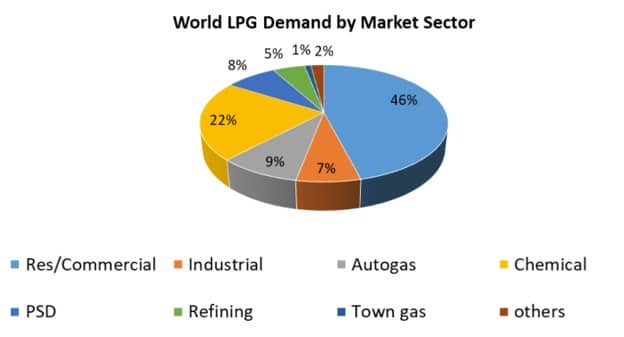
Residential and Commercial Sector: The Global Leader
The residential and commercial sectors are still the largest consumers of LPG to date.
It accounts for almost 46% of the global demand.
It provides more than three billion people with a cleaner and more efficient solution than biomass fuels, such as firewood, dung, or coal.
The shift to this fuel source has particular impacts, especially in Asia and Africa, where government programs have expanded access to LPG across rural and peri-urban households.
Source: [9]
For instance, India’s PMUY program has facilitated the distribution of more than 90 million LPG connections to rural households since 2016, replacing traditional biomass stoves with a cleaner solution.
LPG has plenty of benefits compared to conventional fuel sources.
Households that utilise LPG have been reported to have lower indoor air pollution, which reduces the risk of respiratory illness, improving health outcomes.
From a commercial perspective, LPG is widely demanded for use in establishments, such as hotels, restaurants, and small businesses, especially in regions without access to piped natural gas or where power grids are unavailable.
Chemical Feedstock Sector (Petrochemicals)
LPG, with a varying propane and butane mixture, is a critical component for the petrochemical industry.
It’s used in the production of ethylene, propylene, and butadiene, the key ingredients in the creation of plastics, synthetic rubber, and other polymers.
In the previous year, petrochemical demand represented about 35% of the total LPG global consumption [11].
This growing demand can be traced to China, South Korea [12], and the Middle East, where new steam cracking and propane dehydration plants are rolled out to serve both domestic and export markets.
Additionally, China has added multiple PDH facilities in the last five years, making it one of the largest importers of propane for petrochemical processing.
The chemical sector expansion is expected to be the single biggest driver of incremental LPG demand through 2030.
Industrial Sector
LPG has millions of uses, particularly in industrial applications.
It provides process heat for ceramics, glass, and food processing and is also often used for metal cutting, soldering, and drying processes.
One key industrial application of LPG is in forklifts, where it’s popular in logistics and warehousing due to its low emissions and ability to operate safely indoors, unlike other diesel alternatives.
The hospitality sector mainly relies on LPG for cooking and heating.
Similarly, the agricultural industry utilises LPG for drying crops and maintaining heat in greenhouses.
The industrial sector is responsible for 12-15% of global LPG demand, with steady usage expected over the next couple of years [11].
Autogas Sector (Transport)
Another essential use of LPG is in the transport sector, mainly as a road transport fuel, accounting for 9% of global LPG consumption.
Globally, there are over 27 million Autogas vehicles [13], making it the third-largest alternative fuel used in transportation, which is followed by electricity and natural gas.
The top 5 countries that adopted Autogas include:
- Turkey with over 4 million vehicles
- South Korea with more than 2 million vehicles and a strong taxi fleet
- Russia with an estimated 3 million vehicles, most of which are located outside major cities
- Poland, which leads EU markets with roughly 3 million vehicles
- Australia, which was once a major Autogas market, has seen a decline throughout the years due to the release of EVs and hybrids
Autogas remains an attractive choice for consumers who are looking to lower their fuel costs, as they are lower compared with petrol and diesel.
Its key advantage also lies in its low emissions, producing 10 to 15% fewer CO₂ emissions than petrol.
Yet, it still needs to keep pace with the increasing adoption of electric vehicles in developed markets.
A Tour of the World’s LPG Markets
LPG consumption fluctuates for each regional landscape.
This spans from the Asia-Pacific region, identified as the centre of global LPG demand, to the Americas, which dominate the production and exportation of LPG.
Asia Pacific: The Engine of Global Demand
The Asia-Pacific region is identified as one of the highest consumers of LPG worldwide.
It has a 50% consumption rate of LPG, making it the largest and fastest-growing market among the regions.
Two key drivers of the LPG market in the region include household access programs and the rise of the petrochemical industry.
India
With the help of government programs such as PMUY, LPG has become the primary fuel for household cooking [14].
PMUY facilitated the distribution of more than 90 million connections since its reinforcement in 2016.
With programs such as PMUY, India’s consumption increased to 39 million tonnes per year, placing it in second spot, next to China.
LPG use in the country is entirely residential and commercial.
China
In 2024, China was able to consume over 96 million tonnes of LPG, making it the world’s single largest market [15].
However, compared to India, the majority of China’s LPG demand is centered in petrochemicals, where new propane dehydrogenation plants have made it the largest importer of seaborne propane.
South Korea and Japan
With the increase in electrification, both countries are experiencing a decline in residential demand for LPG.
However, its demand remains high in petrochemical and industrial use.
South Korea is also recognised as one of the top five global Autogas markets, with LPG being the main fuel of its taxi fleet.
In a snapshot, the Asia-Pacific market growth remains influenced by rising incomes, urbanisation, and industrialisation.
Its scale means regional demand trends that directly impact global trade flows and pricing.
The Americas: Production Powerhouse and Mature Market
The Americas present a sharp contrast, where the United States excels in global production and export [16], while Latin America is highly dependent on LPG for residential needs.
United States
The United States is the world’s largest LPG producer, producing more than 25% of the global supply.
Shale gas and tight oil development have transformed the U.S. from a net importer into the highest exporter, with major shipments directed to Asia.
From a local perspective, consumption remains modest compared to output, with only 27 million tonnes per year, where it is used mainly in petrochemicals and rural residential applications.
Canada
Compared to the United States, Canada is a small producer.
Yet, most of its production is exported primarily to Asian markets through the West Coast.
Latin America
Countries in the region, like Brazil and Mexico, are highly reliant on LPG for household cooking and heating.
In Brazil, around 95% of households use LPG cylinders, making it one of the world’s most penetrated residential markets [17].
On the other hand, Mexico exhibits similar trends, where household LPG remains dominant despite the presence of electrification efforts.
The overall profile of the Americas is two-sided; the north focuses on production surplus, while the south has a strong household reliance.
Regardless, they are linked together through intra-regional trade.
Europe: A Leader in Autogas and Policy
Among the continents, Europe is depicted as a policy-driven LPG market, where the adoption of Autogas and decarbonisation strategies is the key driver.
Autogas
Globally, Europe has one of the most developed Autogas markets.
It is equipped with nearly 3 million vehicles, with countries such as Italy, Turkey, and Ukraine reportedly having large fleets of Autogas vehicles.
Policy Impact
The enforcement of EU climate policies encourages the adoption of LPG as a transitional fuel, particularly in transportation and rural heating.
Among conventional fuel sources, LPG stands out as a lower-carbon substitute for coal, heating oil, and biomass, specifically in off-grid rural communities.
Residential or Commercial
Europe shows how regulation and consumer incentives can shape the role of LPG, even in mature and decarbonising economies.
Data on the state of LPG usage in Western Europe is limited.
Still, it is forecasted to have either stabilised or declined due to widespread access to natural gas grids and electricity.
On the other hand, Eastern Europe remains a significant driver of demand, particularly in the region’s rural areas.
The state of LPG in the European market underscores the importance of proper regulation and the implementation of consumer incentives in shaping the role of LPG, even in mature economies focused on decarbonization.
Middle East and Africa: A Region of Contrast
The Middle East and Africa both illustrate the extremes of LPG: some of the world’s largest producers alongside some of the fastest-growing consumer markets.
Middle East
The region is home to various production hubs of LPG worldwide, including Saudi Arabia, Qatar, and the United Arab Emirates.
This region alone is responsible for supplying large volumes of LPG in the market through by-products of natural gas processing and oil refining [18].
Domestically, the utilisation of LPG is high in the region because of its petrochemical industry. Still, exports remain dominant, with the primary destination of its products located in the Asian region.
Africa
As the government continues to reinforce the transition to clean cooking, demand for LPG in the region has increased, replacing biomass and kerosene as the primary source of fuel for cooking.
Several countries in the region, such as Nigeria, Kenya, and South Africa, are leading the charge in LPG adoption.
However, access and affordability of the product remain a barrier in this transition [19].
Data reveal that less than 15% of households in sub-Saharan Africa have access to LPG, but this figure is expected to rise swiftly as distribution networks are being expanded [20].
This region illustrates the dual nature of LPG in the Middle East and African markets, where it serves as a global commodity in the former and a vital solution in the latter.
The Economics of Global LPG
The global LPG pricing and trade are influenced by various critical benchmarks and trade corridors, which connect production sources with demand centres.
Since LPG is both a by-product of natural gas processing and oil refining, its pricing is directly linked to the broader energy market.
Key International LPG Price Benchmarks
Two primary benchmarks dominate the global LPG market, namely, the Mont Belvieu and the Saudi Aramco Contract Price.
Mont Belvieu, United States
Mont Belvieu, located in Texas, serves as the largest LPG storage and pricing hub in the world.
It reflects North American supply essentials, especially those tied to shale gas output [21].
MB pricing sets the reference for US exports and greatly influences global buyers.
As the largest exporter, this benchmark is crucial as the US shipped over 50 million tonnes annually in previous years.
Saudi Aramco Contract Price
Saudi Aramco publishes the contract price monthly that serves as the benchmark for Asia’s LPG trade, reflecting Middle Eastern supply and demand balances [22].
The contract price is particularly influential in long-term supply contracts for China, India, Japan, and South Korea.
Both MB and CP provide the key international price benchmarks for global LPG transactions, with spot and term contracts indexed against these markers.
Exchange rates, freight costs, and regional demand fluctuations are additional factors that add volatility to delivered prices.
Major Global LPG Trade Routes
The global LPG trade follows clear corridors that link low-cost exporters with high-demand regions.
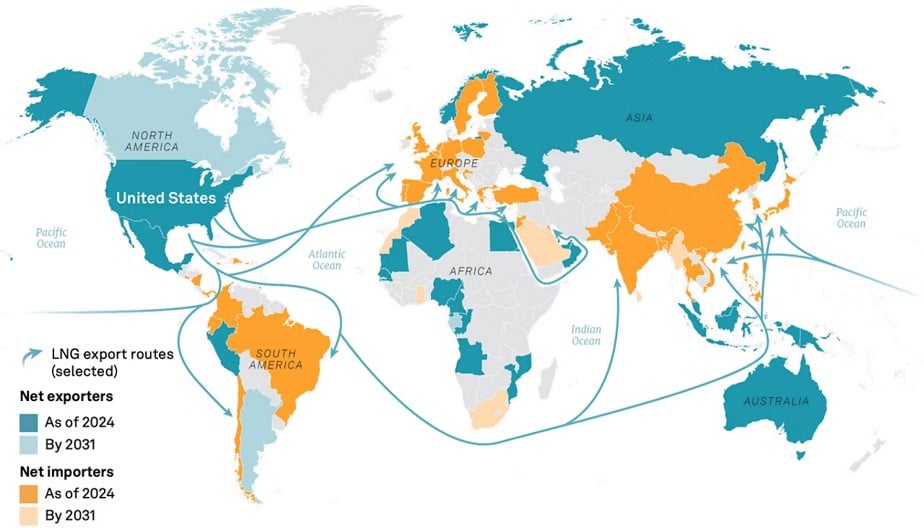
Source: [23]
- U.S. Gulf Coast to Asia: Currently, this is the single largest trading route, which is supported by the shale-driven United States production boom. Top buyers in this route include China, South Korea, and Japan.
- Middle East to Asia: This traditional supply route from Saudi Arabia, Qatar, and the UAE to Asia remains strong, with the contract price anchoring these contracts.
- Intra-regional flows: Latin America imports LPG from the U.S., while Europe sources LPG from both the U.S. and North Africa. On the other hand, Africa increasingly imports from the Middle East to meet its growing household demand.
The Future of Global LPG: Growth, Transition, and Innovation
The future of global LPG remains resilient through 2030, even as energy systems are beginning to decarbonise.
While developed markets may see stagnant or modest declines in household consumption, growth in developing regions and in petrochemicals will offset these trends.
At the same time, advancements in renewable LPG (or BioLPG) promise to future-proof the industry, enabling it to remain a relevant, lower-carbon component in the global energy mix.
Projected Growth by Region and Sector
According to experts from the World LPG Association and the International Energy Agency [24], global LPG consumption could increase to 380 million tonnes by 2030, predicting a 33 million tonne increase.
However, growth may not be evenly distributed.
Source: [5]
Africa
Africa is expected to be one of the fastest-growing regions [25]. Its LPG adoption has accelerated as governments and NGOs push for clean cooking solutions to replace wood and kerosene.
By 2030, an additional 120 million people are expected to gain access to LPG for household use.
Developing Asia
India’s residential demand will begin to stabilise at high levels [24], while China’s petrochemical sector is expected to have continuous expansion, which accounts for the bulk of incremental growth.
Southeast Asian nations, specifically Indonesia and the Philippines, will also contribute through household expansion programs.
Petrochemicals
LPG’s role as a feedstock will remain the single biggest driver of additional LPG demand globally.
Countries like China, South Korea, and those in the Middle East are expected to commission new PDH and steam cracking capacity, aiming to increase demand for propane imports [24].
The Role of LPG in the Global Energy Transition
As countries strive to lower emissions, LPG is being positioned as a transition fuel.
It comes with advantages, such as:
- Lower carbon intensity: LPG emits approximately 15% less CO₂ than petrol and is lower than coal or biomass.
- Air quality benefits: Displacing biomass and kerosene improves indoor and outdoor air quality, especially in developing regions, particularly in Africa, where health impacts from air pollution remain severe [26].
- Energy security: With features such as portability and storability, LPG proves to be resilient for both households and industries in areas where grids or pipelines are not yet available.
LPG can complement renewables by covering sectors and places where electrification is not yet practical or available.
The Emergence of Renewable LPG (BioLPG)
One of the transformative highlights in this sector is the growth of renewable LPG, also known as bioLPG [27].
This product is chemically identical to conventional LPG, making it easy to blend seamlessly within existing supply chains without requiring modifications to appliances or infrastructure.
This renewable form is a by-product of diesel and sustainable aviation fuel plants or through emerging pathways such as gasification and power-to-liquids.
Here’s an updated look at the emergence of BioLPG into the global sustainable energy future.
- Europe leads deployment: Neste’s Rotterdam plant has already begun production of bioLPG, annually producing roughly 40,000 tonnes, which supplies households and businesses across the EU [28].
- Global scaling: By the 2030s, industry predictions suggest that bioLPG could meet up to 30% of total LPG demand in some markets, further reducing CO₂ emissions by as much as 80 to 90% [27].
- Pathway to net zero: Alongside renewable dimethyl ether (rDME) and synthetic LPG, bioLPG offers a credible decarbonisation route for the sector. This ensures continual relevance in a low-carbon future.
Data Sources & References
- [1] IndexBox – World – Liquefied Petroleum Gas (LPG) – Market Analysis, Forecast, Size, Trends, And Insights
- [2] Transparency Market Research – https://www.transparencymarketresearch.com/liquefied-petroleum-gas-market.html
- [3] Precedence Research – Liquefied Petroleum Gas Market Size, Share, and Trends 2025 to 2034
- [4] iMarc – Liquefied Petroleum Gas (LPG) Market Report by Source (Refinery, Associated Gas, Non-Associated Gas), Application (Residential, Commercial, Refinery and Petrochemical, Transportation, and Others), Supply Mode (Packaged, Bulk, and On-site), and Region 2025-2033
- [5] Polaris Market Research – Global Liquefied Petroleum Gas Market Size, Growth 2022-2030
- [6] The Global Economy – LPG consumption – Country rankings
- [7] World Liquid Gas Association – Where does LPG come from?
- [8] WLPGA – WLPGA-Statistical-Review-2023.pdf
- [9] Maximize Market Research – LPG Market – Global Industry Analysis Outlook and Forecast
- [10] Argus – Statistical Review of Global LPG
- [11] Verified Market Reports – Global Liquefied Petroleum Gas (LPG) Market Size By source (Refinery, Associated Gas), By Application (Residential / Commercial, Chemical), By End-use (Residential, Commercial), By Distribution channel (Bulk Distribution, Cylinder Distribution), By Storage (Above Ground Storage, Underground Storage), By Geographic Scope and Forecast
- [12] Reuters – South Korean petchem firms boost cheaper LPG use, raise output
- [13] World Liquid Gas Association – Autogas
- [14] Ministry of Petroleum & Natural gas – Adoption of Clean Fuel for Cooking in Rural Areas
- [15] Evident – VLGC and LPG Markets: Growth and Future Projections for 2025
- Fortune Business Insights – LPG [Liquefied petroleum gas] Market Size, Share & Industry Analysis, By End User (Domestic, Commercial, Agriculture, Industrial, Transport, Refinery Fuel, and Chemical), By Source (Natural Gas Liquid and Crude Oil), and Regional Forecast, 2024-2032
- [16] The Wall Street Journal – U.S. Propane Exports Notch a New Record
- [17] ScienceDirect – The 2023 Latin America report of the Lancet Countdown on health and climate change: the imperative for health-centred climate-resilient development
- [18] Opis – Middle East Gulf LPG Exports Hit Quarterly Record High
- [19] KAPSARC – Role Of LPG In Enabling A Just and Inclusive Energy Transition in Africa And The Arab Region
- [20] Reuters – South Africa poised for LPG gas boom amid electricity price hikes
- [21] Aegis Sef – Normal Butane Fixed Swap – Mt. Belvieu Butane (non-LDH) – OPIS
- [22] Department of Energy – LPG Monitor as of 01 July 2025
- [23] S&P Global – Major New US Industry at a Crossroads: A US LNG Impact Study – Phase 1 | S&P Global
- [24] International Energy Agency – World Energy Outlook 2023
- [25] International Energy Agency – Africa Energy Outlook 2022 – Analysis
- [26] World Health Organization – Household air pollution
- [27] Liquid Gas Europe – Autogas in Europe: The Role of Bulgaria in Driving LPG Adoption and the Future of bioLPG
- [28] Neste – Neste delivers first batch of 100% renewable propane to European market

Eric Hahn has over a decade of experience in the LPG industry and has become a key figure in shaping how LPG is marketed and communicated. As the creator of one of the world’s first LPG blogs, Eric has authored over 200 technical posts, helping educate and inform the industry and consumers.
Eric has served on multiple committees for Gas Energy Australia and the World LPG Association (WLPGA), contributing to important discussions and advancements within the global LPG sector. He has presented at WLPGA Annual Conferences, sharing his expertise as a speaker, panellist, and panel chair.
- Winter on the Manning River: Beautiful but Brisk - July 6, 2026
- The Harsh Reality of June in the Snowy Mountains - July 6, 2026
- The True Cost of a Freezing Guest in the Snowy Mountains - July 6, 2026
Steve Reynolds
Technical Consultant
Steve Reynolds is a leading expert in the LPG industry with over 22 years of experience. As part of the national management team at ELGAS, Steve ensures the safe and efficient storage, handling, and transportation of LPG. He serves as the lead investigator for incidents and collaborates with authorities on industry developments.
Steve is a technical advisor to Standards Australia and Gas Energy Australia (GEA), and an active member of the World LPG Association (WLPGA), contributing to global standards and technical reviews. He holds a BSc. (Hons) in Industrial Chemistry from UNSW and has held senior safety and technical roles at ELGAS, making him a trusted authority in LPG safety and standards.