

1800 STARGAS (1800 782 742)
Reviewed by Richard Fowles, MSc (Eng) Welding Engineering, Metallurgy and Materials Engineering
Fellow of the Institute of Engineers Australia
CO2 – Carbon Dioxide – CO2 Bottle: CO2 Cylinder – Carbonation

CO2 cylinder (CO2 bottle) suppliers with CO2 refill near you (CO2 gas cylinder refill near me) of food grade quality gas.
Food grade carbon dioxide gas comes in CO2 cylinder (CO2 bottle) for CO2 gas refill (tank refill) in VT or F size CO2 cylinder and D size CO2 cylinder (VIC only)
Get a great CO2 bottle price and on our CO2 bottle hire for beer tank refill, too.
Our 99.9% carbon dioxide gas comes in CO2 cylinder (CO2 bottle) and is food grade quality gas.
Soft drink dispensers use food grade CO2.
In addition, we supply CO2 gas in various CO2 bottle sizes at a great CO2 bottle price.
CO2 applications include beer CO2 bottle refill for pressurised beverage dispensing of bulk beer, cider and post-mix systems.
Our CO2 gas cylinder (CO2 gas bottle) hire contain carbon dioxide gas and is a non-flammable, non-toxic, colourless and odourless gas.
 What is CO2? – What is the CO2?
CO2, or carbon dioxide, is a colourless, odourless gas made of one carbon atom and two oxygen atoms (CO2).
It is vital for life as plants use it for food in photosynthesis.
However, it is also a major greenhouse gas from burning fossil fuels, trapping heat and affecting climate, but too much in the atmosphere contributes to global warming
Humans exhale CO2 as a metabolic byproduct, and it’s crucial for blood pH regulation.
Concentrated amounts are an asphyxia hazard.
Key Characteristics of CO2
CO2 chemical makeup is one carbon atom (C) bonded to two oxygen atoms (O).
It is found naturally in the atmosphere (around 0.04%), exhaled by living creatures, and released by volcanoes.
As a greenhouse gas, it absorbs infrared radiation, trapping heat and creating the greenhouse effect, causing climate change.
Sources of CO2
Natural sources include respiration, volcanic eruptions, wildfires, and decomposition.
Human caused sources include burning fossil fuels (coal, oil, gas), cement production, land clearing.
Importance & Effects
CO2 is essential for photosynthesis in plants.
It also regulates blood pH and breathing, as a metabolic waste product.
Escalated atmospheric CO2 from human activity intensifies global warming.
Other applications include dry ice, carbonation in drinks, fire extinguishers, refrigerants, and atmosphere in greenhouses.
CO2 Molecular Formula and Properties
The carbon dioxide molecule has the chemical formula CO2.
It is non-flammable and has a higher density than air (heavier than air).
When chilled sufficiently, it can also take the form of dry ice.
Natural Sources of CO2 and Human Caused Sources
Animals, including humans, exhale CO2 (carbon dioxide) as metabolic waste.
Geothermal and volcanic eruptions also release CO2.
Decomposing organic materials also release CO2.
Sourced as the Result of Human Activities
Burning of fossil fuels to generate heat and energy also cause CO2 emissions.
For example, coal for electricity generation and oil for transportation both emit large quantities of carbon dioxide.
Burning of waste and certain chemical processes also generate CO2 emissions.
Uses of CO2
Plants use CO2 in photosynthesis whilst also generating oxygen.
It is also used for carbonation of drinks, dry ice and chemical fire extinguishers.
CO2 Cylinder – CO2 Bottle – CO2 Tank
CO2 cylinder (CO2 bottle) or CO2 tank are made from steel and fitted with a valve.
Available CO2 cylinder sizes (CO2 tank sizes) are varied.
Typical pressure of a carbon dioxide bottle is 4,500 kPa at 15°C.
The standard Australian colour code for a CO2 cylinder (CO2 bottle) is Green Grey.
Carbon Dioxide Bottle Sizes – CO2 Cylinder Sizes – CO2 Tank Sizes – CO2 Bottle Sizes
VT or F size CO2 cylinder and D size CO2 cylinder (VIC only)
CO2 tank sizes (CO2 cylinder sizes) or CO2 bottle sizes include VT and F size CO2 cylinder (CO2 gas bottle) sizes.
However, D size CO2 cylinder is also available in Victoria.
You just pick the CO2 tank sizes, CO2 bottle sizes or CO2 cylinder sizes that best suits your needs.
CO2 cylinder sizes (CO2 bottle sizes) are shown in the chart below, including bottle sizes and dimensions:
|
CO2 Cylinder Sizes – CO2 Bottle Sizes – CO2 Tank Sizes Chart
|
|||
| CO2 Bottle Sizes: | CO2 Cylinder Sizes: Diameter | CO2 Bottle Sizes: Height | CO2 Tank Sizes: Tare Weight |
| VT size CO2 cylinder:: | 215mm | 625mm | 13.5kg |
| F size CO2 cylinder: | 215mm | 1245mm | 23.5kg |
| D size CO2 cylinder: | 170mm | 750mm | 20kg |
| Actual dimensions and tare weights may vary by CO2 tank sizes, CO2 bottle sizes or CO2 cylinder sizes | |||
CO2 Refill Near You (CO2 Gas Cylinder Refill Near Me): Beer CO2 Cylinder Refill – CO2 Bottle Refill – CO2 Bottle Price – CO2 Gas Refill Price
CO2 refill near you (CO2 gas cylinder refill near me) or CO2 bottle refill (CO2 cylinder refill) is done at our facility and we exchange a full bottle for an empty one.
Our CO2 bottle price for a CO2 refill near you (CO2 gas cylinder refill near me) is very competitive and includes free delivery in our normal service areas.
CO2 gas cylinder (CO2 gas bottle) price and CO2 gas refill price – Contact us for a quick online cylinder price quote on 1800 782 742

Stargas New Customer Offer
$50 Off First Order
Quote offer SG50 when placing your first gas order
Valid 1 November 2025, expiring 31 October 2028
CO2 Hire – CO2 Bottle Hire with CO2 Refill Near You (CO2 Gas Cylinder Refill Near Me)
CO2 hire (CO2 bottle hire) is a great way to get your cylinder.
CO2 refill near you (CO2 gas cylinder refill near me) is the way to refill them.
No need to buy the steel cylinder, as we offer CO2 cylinder hire (CO2 bottle hire).
Just call us for all of the CO2 hire details on 1800 782 742
Beer Tank Refill – Beverage Gases
 CO2 is commonly used as beer gas.
Beer tank refill gas is typically used in beverage dispensing for carbonation, pressurisation, head retention and preservation.
- Beer tank refill gas for carbonation of beer, soft drinks and cider
- CO2 bottle provides pressurisation in order to push liquid from storage source to dispensing point
- Beer tank refill for beer head retention after it is poured
- CO2 gas provides preservation and extending product shelf life.
Carbon Dioxide Bottle Delivery
We provide free CO2 cylinder (CO2 bottle) delivery anywhere within our normal service area.
Same for CO2 refill near you (CO2 gas cylinder refill near me).
Typically, we deliver your carbon dioxide gas cylinder by the next day.
Just give us a call on 1800 782 742.
Carbon Dioxide (CO2) Applications
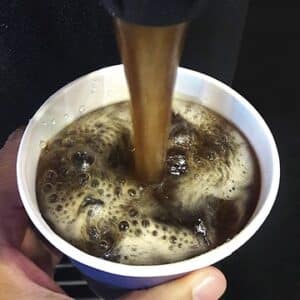 Carbon dioxide (CO2) applications include beer dispensing, restaurants, soft drink carbonation, welding and wine dispensing, fire extinguishers, chemical feedstock, paintball guns and as dry ice.
The applications are varied, which is why Stargas is committed to the excellence of our products and services and aim to ensure our products meet the quality specification every time.
It is important to us that your customers keep coming back.
Our focus on high quality includes:
- HACCP and ISBT accreditation for our Food Grade Carbon Dioxide Gas
- Safety Data Sheets available anytime: MSDS CO2 – Carbon Dioxide Gas
- The ability to provide quality batch test results or certificates for our products as part of a solution.
Liquid CO2 and Frozen Carbon Dioxide – Dry Ice
Carbon dioxide can exist as a gas, a liquid or a solid.
Solid carbon dioxide is typically found in the form of dry ice.
Density of CO2 Gas – Carbon Dioxide Gas
Density of CO2 gas is 1.98 kg/m3.
Carbon dioxide is approximately 1.67 times the density of air.
Industrial gas suppliers in metropolitan areas of Melbourne, Sydney, Brisbane, Gold Coast & Sunshine Coast
Frequently Asked Questions – FAQs:
CO2 - What is the CO2 - CO2 what is - what’s CO2? - CO2 gas
CO2 is the chemical formula for carbon dioxide, a colourless, odourless, non-flammable gas essential for life but also a major greenhouse gas.
CO2 gas is a molecule composed of one carbon atom and two oxygen atoms.
CO2 gas occurs naturally in the atmosphere, is a byproduct of human and animal respiration, and volcanic eruptions.
It’s crucial for plant life, as plants use it for photosynthesis.
CO2 gas is a greenhouse gas that traps heat in the atmosphere, which is necessary to keep the planet warm enough for life.
However, human activities, such as burning fossil fuels, deforestation and industrial processes like cement production, are the main contributors to the rapid increase in atmospheric CO2 and global warming.
CO2 Uses
CO2 has many uses, including carbonation in soft drinks, use as a chemical fire extinguishing agent, and as dry ice for cooling or smoke effects.
Health effects:
High concentrations of CO2 can be harmful.
Symptoms include headaches, dizziness, and difficulty breathing.
In very high concentrations, CO2 can be fatal.
Lewis formula for CO2 - Lewis structure for CO2 - Lewis dot structure for CO2 - CO2 Lewis formula - CO2 Lewis structure

The Lewis formula for CO2 (Lewis structure for CO2 or Lewis dot structure for CO2) shows a central carbon atom double bonded to each of the two oxygen atoms (O=C=O).
Each oxygen atom also has two singular pairs of electrons, with the carbon atom having no singular pairs, resulting in a total of 16 valence electrons (4 from carbon, 6 from each of the two oxygen atoms) in a linear molecule.
CO2 Emissions - Australia CO2 emissions?
Australia’s CO2 emissions were 446.4 million tonnes of carbon dioxide equivalent (Mt CO2e) for the year to December 2024. This was an increase of 0.05% (0.2 Mt CO2e), which is effectively flat compared to the previous year, according to the Australian Bureau of Statistics and DCCEEW.
This level is 27% less than 2005 emissions, the baseline year for the Paris Agreement.
Key sectoral changes for the year to December 2024 included increased transport emissions and a decrease in industrial processes, according to DCCEEW.
Is CO2 polar? Is CO2 a polar molecule?
No, carbon dioxide CO2 is not a polar molecule because it is linear and symmetrical, causing the two polar C=O bonds to cancel each other out.
Although the individual carbon-oxygen bonds are polar due to oxygen’s higher electronegativity, the molecule as a whole has a net dipole moment of zero.
Linear and symmetrical structure:
The CO2 molecule has a linear shape with the carbon atom in the center and an oxygen atom on each side (𝑂=𝐶=𝑂).
Polar bonds:
Oxygen is more electronegative than carbon, so it pulls electron density more strongly, creating a partial negative charge on the oxygen atoms and a partial positive charge on the carbon atom.
This means each C=O bond is polar.
Cancellation of dipoles:
The two polar bonds are oriented 180∘ apart.
The pull of the electrons by one oxygen atom is exactly equal and opposite to the pull by the other oxygen atom.
This results in the bond dipoles cancelling each other out, leading to a net dipole moment of zero.
Nonpolar molecule:
Because the molecule has no net dipole moment, it is considered nonpolar.
CO2 Molecule - CO2 structure - molecular weight of CO2?
 CO2 Molecule
The carbon dioxide (CO2) molecule is a linear molecule with a molecular weight of approximately 44.01g/mol.
CO2 Structure
The CO2 molecule has a linear geometry, meaning all three atoms lie in a straight line with a bond angle of 180∘
- Bonding: The carbon atom forms two double covalent bonds, one with each oxygen atom (O=C=O).
- Hybridization: The central carbon atom is 𝑠𝑝 hybridized.
- Polarity: The molecule is nonpolar because the symmetric linear shape causes the bond dipoles to cancel each other out.
Molecular Weight of CO2
The molecular weight (or molar mass) of carbon dioxide is calculated by summing the atomic weights of one carbon atom and two oxygen atoms.
Calculation:
Atomic mass of Carbon (C) ≈12.011g/mol is approximately equal to ≈12.011g/mol
Atomic mass of Oxygen (O): ≈15.999g/mol is approximately equal to ≈15.999g/mol
Total Molecular Weight (MW)
MW=12.011+2×15.999=44.009g/mol
The approximate molecular weight is 44.01g/mol or 44.01amu
Define CO2 - definition CO2? - CO2 definition
CO2 is the chemical formula for carbon dioxide, a colourless, odourless gas composed of one carbon atom and two oxygen atoms. It is a natural component of Earth’s atmosphere, essential for plant life through photosynthesis, and is produced by animals as a waste product of respiration. It is also a major greenhouse gas that plays a critical role in regulating the Earth’s temperature.
Chemical composition and properties
- Chemical formula: CO2
- Molecular structure: A linear molecule consisting of one carbon atom double-bonded to two oxygen atoms
- Properties: Colorless, odorless, and non-flammable
Biological and atmospheric role
- Respiration: Both animals and humans exhale
CO2 as a metabolic byproduct.
- Photosynthesis: Plants use
CO2 from the atmosphere to produce their own food, releasing oxygen in the process.
- Carbon cycle:
CO2 is a key part of the global carbon cycle, linking the atmosphere, plants, and other parts of the environment.
Greenhouse Gas
Heat absorption: As a greenhouse gas, CO2 absorbs and re-radiates heat from the Earth’s surface, which helps maintain a habitable temperature on the planet.
- Atmospheric concentration: While it makes up only about 0.04% of the atmosphere, it is one of the most important long-lived greenhouse gases.
- Sources:
CO2 is produced by both natural processes (like respiration and decomposition) and human activities (like burning fossil fuels).
Atmosphere CO2 - CO2 atmospheric levels - CO2 levels - Atmosphere CO2 concentration? CO2 levels - Atmosphere CO2 concentration - CO2 from atmosphere
While CO2 atmospheric levels make up only about 0.04% of the atmosphere, it is one of the most important long-lived greenhouse gases.
Is CO2 an acid?
CO2 is not an acid, but when it dissolves in water, it forms carbonic acid (H2CO3), which is a weak acid.
It can then release hydrogen ions (H+) into the solution, making it more acidic.
So, while CO2 is not an acid in isolation, it is considered an “acidic gas” because of its reaction with water.
As an example, when water is carbonated, the dissolved CO2 creates a weak carbonic acid solution.
Is CO2 carbon dioxide?
Yes, CO₂ is the chemical formula for carbon dioxide, a molecule composed of one carbon atom and two oxygen atoms.
It is a colourless, odourless gas that occurs naturally and is also produced by human activities like burning fossil fuels.
It is non-flammable, stable, and not toxic, although in high concentrations it can be an asphyxiation hazard, as it displaces oxygen.
Is CO2 flammable – Is CO2 combustible?
Carbon dioxide (CO2) is neither flammable nor combustible.
CO2 is a non-flammable gas that is the product of complete combustion.
Carbon dioxide is created when a carbon based fuel burns completely in the presence of oxygen, meaning it is already fully oxidized.
This means it is unable to react further with oxygen to produce a flame.
CO2 is often used as a fire suppressant, as it does not support combustion.
As it is a stable molecule that will not oxidize, it is used to displace oxygen to extinguish fires.
Carbon dioxide should not be confused with carbon monoxide
CO2 should not be confused with carbon monoxide (CO), which is a toxic gas that is highly flammable.
Is CO2 heavier than air?
Yes, carbon dioxide (CO2) is heavier than air at standard temperature and pressure.
This is because the molecular weight of CO2 is greater than the mixture of gases that make up air, including primarily nitrogen and oxygen.
At room temperature, CO2 has a higher density (1.98kg per m3) compared to air (1.29kg per m3).
CO2 settles in low-lying areas, like trenches, basements, or sumps, and displaces air/oxygen.
This is why it can be an asphyxiation hazard in confined, poorly ventilated spaces.
CO2 cylinder colour - CO2 gas cylinder colour - Colour of CO2 cylinder?
The colour of a CO2 cylinder varies by country and supplier.
For example, in Australia, the standard colour is green grey.
It is grey in the USA.
CO2 Structure
The structure of carbon dioxide (CO2) is a molecular geometry that is linear, with a central carbon atom that is double-bonded.
The molecule also has two oxygen atoms, on opposite sides of the carbon atom, forming a straight line, with a bond angle of 180∘.
The molecule has a symmetrical charge distribution due to the double bonds and solitary pairs on each oxygen atom.
The electron arrangement of the two oxygen atoms is spread out symmetrically on opposite sides of the carbon atom, minimising electron repulsion.
The Lewis structure shows a central carbon atom with two solitary pairs of electrons on each oxygen atom, and a double bond between the carbon atom and each oxygen atom.
CO2 Molar Mass
CO2 molar mass or molar mass of carbon dioxide is 44.009 g/mol.
CO2 as a Liquid - Liquid CO2
Liquid CO2 is the dense, clear, colourless liquid form of carbon dioxide, used widely for carbonating drinks, in fire extinguishers and food freezing.
It is made when CO2 gas is cooled and compressed into liquid form.
It exists under pressure (above ~5 atmospheres) and specific temperatures between its triple point (-56.6°C) and critical point (31.1°C)..
It is stored in cylinders or tanks at high pressure (45-65 bar) or refrigerated to around -15°C to -35°C.
CO2 is denser/heavier than air and does not support combustion.
Safety precautions must be observed as high concentrations can displace oxygen, causing asphyxiation.
Also, containers can rupture violently if overheated.
Dry Ice and Dry Ice Abrasive Blasting - What is Dry Ice? Dry Ice Temperature
Dry ice is solidified carbon dioxide (CO2), made extremely cold -78.5°C (-109.3°F) – dry ice temperature – that turns directly from solid into gas (sublimates) at normal pressure without becoming a liquid.
This makes it great for cooling without creating moisture.
It is a translucent white solid, odourless, and tasteless, typically formed into pellets, blocks, or slices.
Used for shipping perishables like frozen foods, fake fog special effects, dry ice blasting with a dry ice blasting machine (dry ice blaster), and scientific cooling.
For safety, dry ice must be handled with gloves, to avoid severe frostbite risk, and stored in ventilated containers to avert pressure development, as it is a frozen gas.
Dry Ice Safety
Always use thick gloves or tongs to handle to avoid instant frostbite.
Use in well-ventilated areas only, as the gas displaces oxygen.
Store in an insulated, non-airtight container like a cooler (esky) to allow gas to escape.
Never swallow dry ice as it can cause internal injuries.
Where to Buy Dry Ice – Where Do You Buy Dry Ice?
You can buy dry ice from gas companies (like BOC) and ice suppliers in Australia.
Show Me My Gas Price

“Ordering was easy to do online and delivery was quick” – Comcut Group
“Good order processing and product delivery services.
” – G B Engineering & Design
“When I need gas I just make one phone call and the gas is delivered the next day and as I use direct debit payments are easy.” – Alan S.
“Excellent service and your gas price is very good keep it up thanks” – Victorian Wrought Iron
“I find the phone staff and the delivery driver know their jobs well and everything happens seamlessly.” – Sass Sampling & Storage Sol Pty Ltd
“We are a first time customer as we have changed suppliers and there was an effortless transition.” – Boan Industries
“Very fast and easy to get set up. Delivered the tanks in 24 hours. Thank you.” – Rocket Networks Pty Ltd
“Always great service.. Would highly recommend over Supagas everyday of the week.” – Knowles Cranes Pty Ltd