
Global Renewable Energy Statistics (Trends, Forecast & Usage)
Renewable energy output is scaling to a historic global record as countries cut the cord on fossil fuels.
In the previous year, low-carbon electricity generation peaked at 40.9% worldwide [1].
In fact, renewables are on track to power nearly half the planet at the end of this decade.
Though global renewable capacity is forecast to grow 2.7 times, it still falls short of tripling for the 2030 goals.
Besides net-zero targets, the renewables sector is closing in on the global energy access gap.
While it faces ongoing hurdles, ramping up its operations provides an inclusive and sustainable energy future for all.
Let’s crunch these data points to track renewable energy progress at a global scale:
- Record Investment: Worldwide investment in clean energy is expected to reach USD3.3 trillion this year, attracting twice as many investors as fossil fuels [2].
- Global Footprint: Renewable energy capacities extend to over 150 countries, including territories [3].
- Global Transition Index: Roughly 65% of the countries globally have improved their renewable energy transition scores. Yet, only 28% of these have improved their readiness for change [4], curtailing progress for clean energy solutions.
- Renewable Growth: Renewable power-generation capacity has surpassed 15.1% in the previous year, setting a record since 2000 [5].
- Local Actions: In Australia, an AUD3.5 billion investment in renewables and grid infrastructure projects was authorised in 2024-25, double the previous year’s amount [6].
Renewables are decarbonising the global energy mix, ultimately reducing global warming by 1.5°C.
As such, it has marked a turning point in positioning clean energy as a central need.
The Unstoppable Growth of Global Solar
Solar power has come a long way in the energy industry, from being considered a luxury to possess to becoming an essential foundation for the electricity system.
Global solar PV capacity has increased in recent years, with installed capacity reaching roughly 2,247 GW.
As of 2025, figures show a steady pace, with 380 GW added in the first half of the year [1][7].
Source: [8]
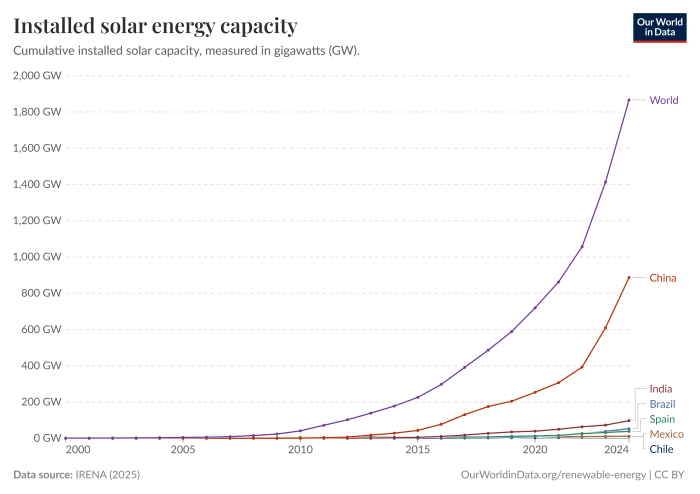
The figure above shows the installed solar energy capacity from 2000 to 2024.
Solar energy capacity rose from less than 100 GW in 2010 to 200 GW by 2015, with continued growth since then.
This trend continued to rise in recent years.
By 2024, the global solar energy capacity had surpassed 1,800 GW.
Among several countries leading the rise in solar energy capacity, China stands out as the major contributor, with roughly 900 GW.
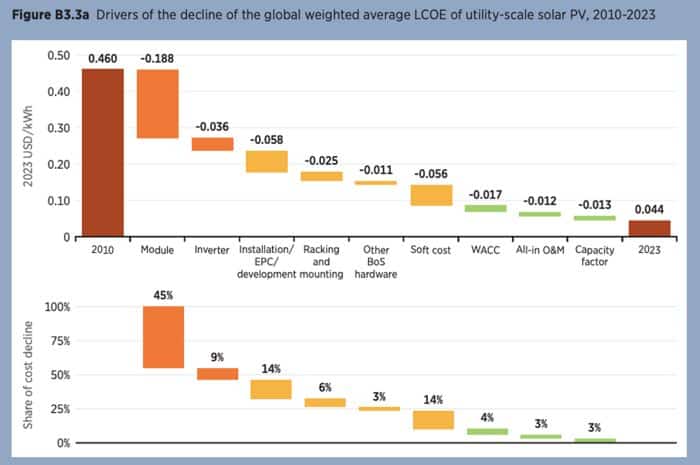
There are two factors explaining the continuous growth of solar technology: industrialisation and cost reduction.
The graph below shows the decline of the global weighted average LCOE of utility-scale solar PV, standing at $0.44/kWh in 2023.
Source: [9]
Several countries are responsible for a disproportionate share of global new solar capacity.
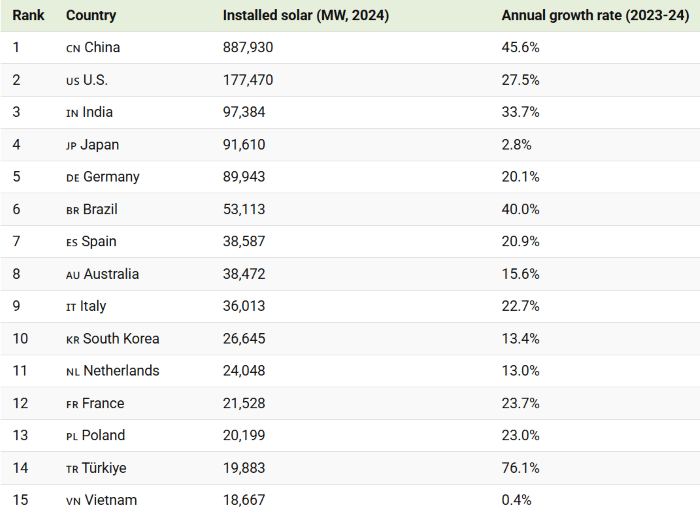
In the previous year, China was the largest contributor, while the United States, India, Japan, and Germany remain the world’s largest cumulative solar markets.
Below is a table that shows the different countries that led solar installations in the previous year.
Source: [10]
From the table above, China has a very large solar capacity, even when the 2nd to 10th countries are added together.
This annual growth in solar installations strongly suggests China’s investment in cleaner energy technology.
Scaling and cost reduction are two factors that allow solar technology to be the centre of any credible decarbonisation strategy, but integrating this technology too fast also brings challenges, like grid integration and land use.
The Expanding Horizon of Onshore and Offshore Wind Renewable Energy
Another energy solution taking a mammoth share in the global clean energy future is wind energy.
Before, the idea was confined solely to scattered onshore wind farms, but the industry has pushed further in the past decade.
Wind energy is proposed for massive offshore projects to power millions of homes, as it is one of the fastest-growing and most mature renewable technologies, supplying clean, reliable power.
In 2023, 117 GW of new wind power was added to the global wind capacity, hitting the highest figures on record, up 50% from 2022.
This increase in wind power capacity has brought the global installed capacity to over 1,000 GW, a significant milestone for the industry [11].
At this rate, if capacity continues to double, by 2030, the total wind energy capacity will reach 2 TW.
Source: [12]
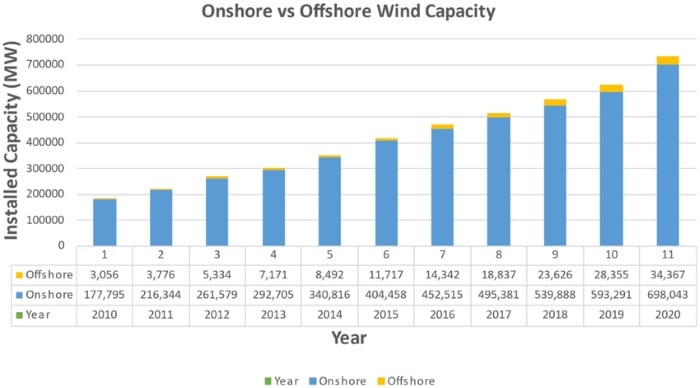
The graph above shows the 10-year growth in global wind capacity between offshore and onshore wind.
Onshore wind is gaining greater traction over the years, especially with modern innovations that enable deep water deployment.
Onshore wind accounts for around 90% of cumulative installed capacity and remains the backbone of global deployment.
It is also thriving further due to its lower cost, shorter project timelines, and maturing supply chains.
On the one hand, offshore wind is expected to reach nearly 18% of total capacity by 2030.
The LCOE for new onshore wind has decreased to US$0.033/kWh in 2023, making it one of the cheapest sources of new and clean energy in the world [13].
Moreover, modern onshore turbines are more efficient than they were a decade ago, averaging 26 MW turbine capacity and 270 metres of rotor diameter.
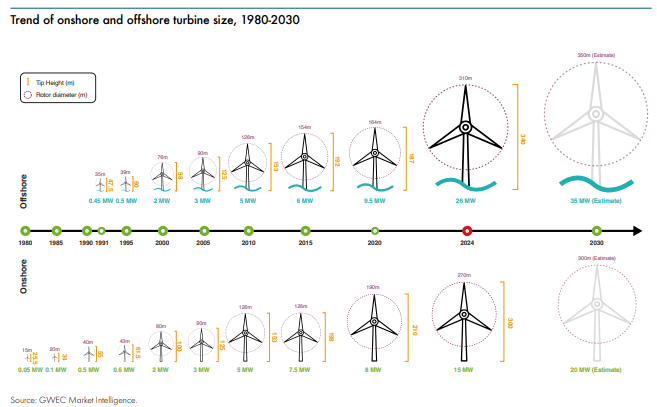
Source: [14]
The size and innovation of onshore and offshore turbines have greatly grown, with commercial models expected to reach 20 MW per turbine and blades stretching up to 300 metres each by the end of this decade.
One rotation of this type of turbine could power an average home for over two days, highlighting efficiency.
Wind energy is seen as a global catalyst for decarbonisation, curbing over 1.2 billion tonnes of CO2 emissions each year. In perspective, that is equivalent to removing 250 million cars from the streets.
As the global wind sector expands, it could also support over 3.5 million jobs in manufacturing, logistics, operations, and maintenance [14].
The Enduring Power of Water Renewable Energy
Aside from the solar and wind energy’s fast expansion, hydropower remains steady and dispatchable.
Even as newer renewable energy technologies take the spotlight, global energy output indicates that hydropower is the backbone of modern, resilient grids.
Hydropower generate 4,300 TWh of electricity per year.
This sector is responsible for over 55% of global renewable electricity and 15% of total power generation.
Recent data suggests that the current installed hydropower capacity worldwide is around 1,400 GW, expected to grow to 1,700 GW by 2030 [15].
The top countries that produce hydropower are China, Brazil, Canada, the United States, India, and Russia.
They account for almost two-thirds of global hydropower generation, with China alone producing over 421 GW.
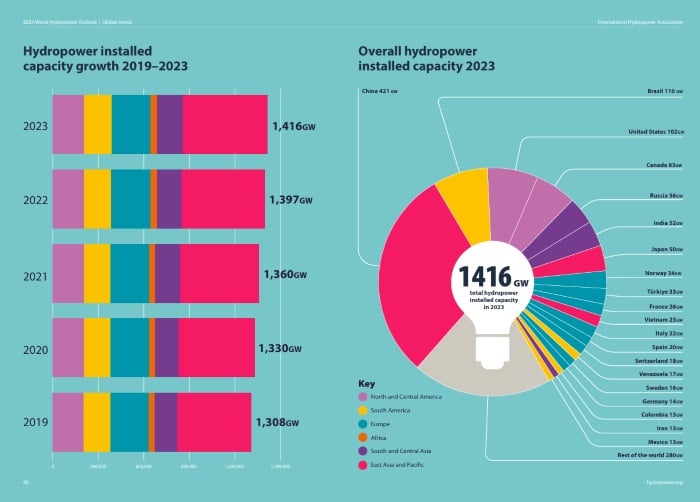
Source: [15]
Unlike solar and wind energy, hydropower can easily provide on-demand electricity that ramps up within seconds to help balance grid fluctuations.
Hydropower’s flexibility makes it an essential backbone for intermittent renewables, helping maintain voltage stability and preventing blackouts during periods of low output from wind and solar.
Hydropower is also known as the world’s largest energy storage system through pumped-hydro facilities, accounting for 90% of global energy storage capacity [16].
This system easily stores excess renewable energy during off-peak times and releases it when demand spikes by moving water between the upper and lower reservoirs, maintaining energy supply.
Hydropower is highly valuable with its ability to bridge intermittency and ensure reliability across grids when fluctuations and imbalances occur.
As countries pursue net-zero targets, large-scale hydro and pumped-hydro systems provide energy storage and grid stability to integrate large amounts of solar and wind power.
Decarbonising the Hard-to-Abate Sectors with BioLPG and Biomethane
Electrification is racing against the clock to power every sector, but limits remain present.
Bioenergy is filling the power gap for millions of off-grid homes and businesses that require dense, storable, drop-in solutions.
BioLPG and biomethane are the front-runners in biogases.
Both can leverage existing infrastructure, appliances, and equipment without modification, while reducing lifecycle greenhouse gas emissions over time.
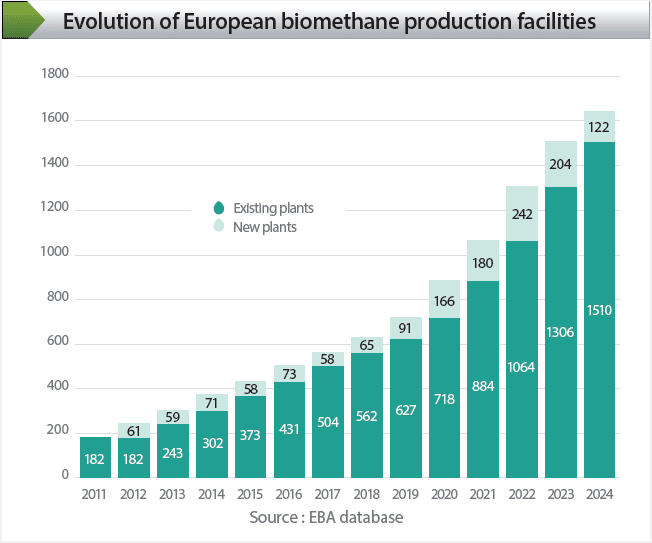
Biomethane is quickly scaling, with current output roughly 20% p.a. Europe leads the world in grid-connected plants, with 1,678 in operation as of the first quarter of 2025 [17].
Source: [17]
The graph shows that the trend only continues to increase in succeeding years, noting that in 2021, there were a total of 1,023 plants, and rose to 1,322 after a year.
The total number of biomethane production facilities in Europe is around 1,678, and is expected to increase in the upcoming years.
While biomethane continues to scale up, BioLPG is gaining traction in the commercial market.
This is because BioLPG is yet to be fully rolled out by 2025-26, where it is expected to multiply several times once available.
Source: [18]
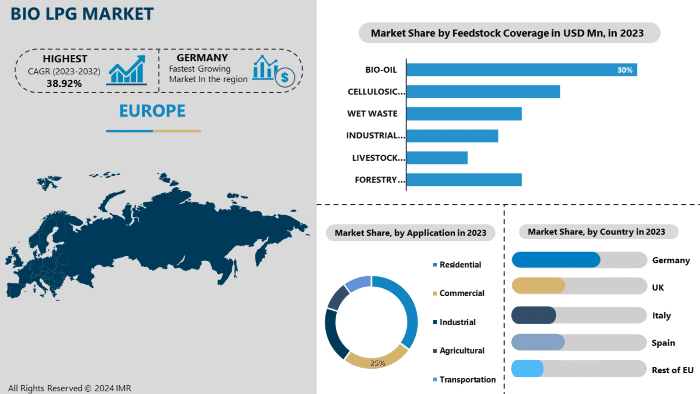
In the infographic above, Germany leads the European region with more than half of the BioLPG market share.
Among sectors, transportation, followed by commercial use, is driving BioLPG adoption, indicating a readiness to transition away from conventional LPG.
On another note, both biomethane and BioLPG offer substantial GHG savings compared to their fossil-fuel equivalents.
Even so, feedstocks should be sustainably sourced, and methane management should be robust to ensure GHG lifecycle reduction.
As long as unmanaged waste is curbed, biomethane from waste feedstock could bring lifecycle emissions as close to zero or even negative [19].
Similarly, for BioLPG, industrial data shows that the typical lifecycle of CO2 emissions was reduced around 60-80% versus conventional LPG, with higher savings expected depending on feedstock and production process [20].
Projecting the Trajectory to a Net Zero Future with Renewable Energy
The transition towards a cleaner energy future has surpassed ambition.
As countries close in on net-zero goals, this can be pushed further with investments for low‐carbon generation, energy storage and robust electricity networks.
A recent report reveals that investment and spending on clean energy technologies have surged to USD 2 trillion in the previous year, with common investments including renewables, grids, and electric mobility [21].
By 2030, it is expected that renewable energy will supply approximately 61% of global electricity, up from 29% in 2020.
By 2050, this will reach 88% of the worldwide electricity generation, provided transitions are accelerated and seamless in the coming years.
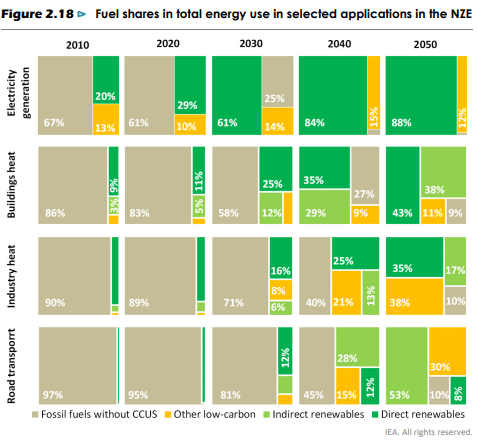
Source: [22]
Future renewable energy production is expected to be led by solar PV and wind.
Although bioenergy, renewable energy gases, and hydrogen also trail behind in decarbonising sectors where electrification is scarce or difficult to apply.
Most of the emissions reductions needed by 2050 are powered by technologies currently in their prototype stage.
This means innovation is still in progress to achieve cleaner energy goals.
For instance, in Australia, biomethane injection projects and renewable hydrogen hubs are mobilised to incorporate clean molecules into their existing gas infrastructure.
The path towards a net-zero future is not straight.
While it requires government policies, investments, and technology, the rollout of renewables provides a strong, reliable, and affordable net-zero energy future.
Methodology & Sources Renewable Energy
[1] Ember – Global Electricity Review 2025
[4] World Economic Forum – Fostering Effective Energy Transition 2025
[5] Creamer Media – Renewables capacity grows, but regional divides persist
[6] Reuters – Australia’s green bank makes record $2.3 billion in clean energy investments
[7] REN21 – Global Status Report 2025
[8] Our World in Data – Total solar capacity
[9] PV Magazine – Global average solar LCOE stood at $0.044/kWh in 2023, says IRENA
[10] Visual Capitalist – Ranked: The Countries With the Most Solar Power Installed
[11] IRENA – Technologies
[12] Research Gate – Global wind capacity (Onshore vs Offshore)
[13] IRENA – RENEWABLE POWER GENERATION COSTS IN 2023
[14] GWEC – Wind Power: A cornerstone of Green Recovery
[15] IHA – Facts about hydropower
[16] IHA – Pumped Storage Hydropower
[17] GIE – Europe Surpasses 1,600 Biomethane Plants: GIE and EBA Release 2025 European Biomethane Map
[18] IMR – Bio LPG Market Expected To Reach USD 7341.16 Million by 2032, Growing At CAGR 36.89%
[19] IEA – Outlook for Biogas and Biomethane
[21] IEA – Overview and key findings
[22] Net Zero by 2050 – A Roadmap for the Global Energy Sector