
Global Renewable Biogas, Biomethane & BioLPG Statistics (Trends, Forecast & Usage)
Renewable Biogas, Biomethane, and BioLPG, once considered niche innovations, are now core players in the global energy mix. These sustainable fuels are a strategic key to decarbonising sectors that either have no direct access to electricity or face difficulties with electrification.
As global population growth redefines fuel demand, countries are developing the blueprint for net-zero emissions. As such, all play a critical role in achieving renewable energy capacity and reducing carbon emissions by 2030.
The central question is how abundant biomass supplies can build secure, sustainable gas fuel options. Below are a few key statistics that define the current renewable biogas sector globally:
- The global biogas market was valued at US$82.1 billion in the previous year, and is expected to increase further to US$87.7 billion as demand for clean gas intensifies[1].
- Investment opportunities in biogas and energy-from-waste in Australia are gaining pace, estimated at around A$3.5 billion to A$5 billion, potentially curbing up to 9 million tonnes of CO2 emissions per year [2].
- Major energy networks now consider biogas or biomethane among foundational decarbonization routes globally [3].
- The global biogas or biomethane market is expected to increase fivefold by 2035 under current policy and investment conditions, with an expected 22% increase between 2025 to 2030 [4].
- LPG exports in Australia rose by 7% from 2023 to 2024, to 128.5 PJ, indicating the growing demand for flexible fuel solutions [5].
These key figures show the growing use of sustainable fuels in the upcoming years, and a raft of initiatives and incentives supporting biogas is critical to global climate and energy security goals.
A Simple Guide to How Renewable Gases Are Made
Have you ever wondered how renewable gases are produced? In this section, we will explore the various methods by which massive plants produce renewable gases through an easy-to-understand infographic.
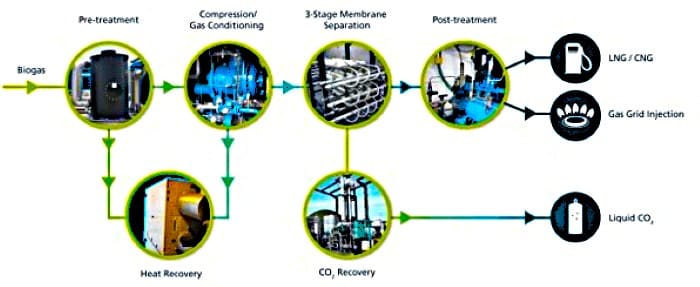
Source: [6]
Step 1: Biogas Production
The first step involves anaerobic digestion, which requires an oxygen-free digester upon storing organics, agricultural residues, or wastewater sludges. Inside the digester, microbes break down these organic wastes from various sources, producing biogas [7].
This process then traps methane that otherwise escapes as a potent greenhouse gas, recovering biomethane that still requires a series of processes to refine and remove impurities.
Step 2: Biomethane Upgrading
Produced biogas still undergoes a few steps before it can be fully utilised as a direct gas replacement. This includes water scrubbing, pressure swing adsorption, and other essential steps that help remove CO2, H2S, moisture, and other impurities.
That way, it increases methane content to almost 97%, and generates biomethane [8]. Generated biomethane can either be directed into natural gas pipelines or used in compressed form for heating, transport, or industrial purposes.
Step 3: BioLPG Synthesis
BioLPG is created through separate but complementary pathways from biomethane production. In most countries, bio-propane or bio-butane is produced as a drop-in replacement for conventional LPG.
This means it can be utilised with current cylinders, appliances, equipment, and pipes without further modification [9]. Generating bioLPG requires two pathways: hydrotreating vegetable oils or fatty waste, and gasifying biomass via Fischer-Tropsch Synthesis.
These stages of renewable gas production create a seamless renewable gas value chain, beginning with waste to high-purity gas to clean liquid fuel. Such renewable energy production reflects access to an energy-secure, lower-emission gas solution without requiring any modifications or new infrastructure to existing appliances or supply chains.
Global Biogas Landscape: Production, Feedstocks, & Key Regions
Once developed from pilot projects, biogas has become a core player in the global renewable energy mix. It generates massive tonnes of dispatchable, low-carbon fuel, with emissions reduced to a fraction from most alternatives.
Biogas, Biomethane and BioLPG Production by Region
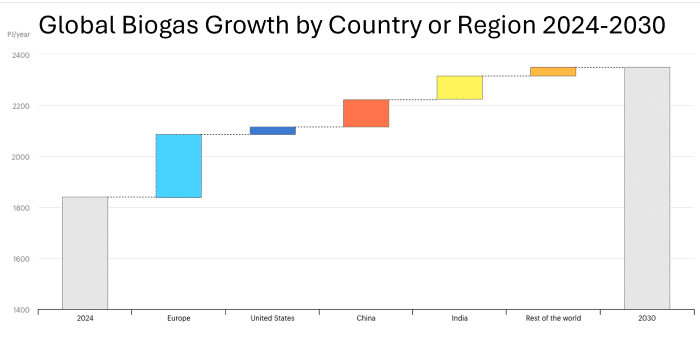
IEA (2025), Global biogas growth by country or region, 2024-2030, IEA, Paris, Licence: CC BY 4.0
Source: [20]
Europe leads the world in biomethane distribution in grids. The 2025 European Biomethane Map reports that the region has 1,678 active biomethane plants. Given that 86% of these are connected to the grid, Europe pioneered large-scale grid integration [11].
Asia and America are also scaling quickly. India’s huge household and community digester programme, in conjunction with its huge waste-to-energy projects, means the region is responsible for a large share of global small-scale biogas capacity.
On the other hand, North America is expanding large-scale upgrading and RNG projects for transport and pipeline injection.
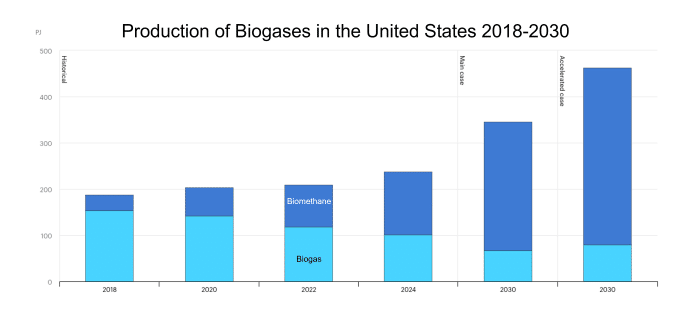
Production of Biogas in the United States
Feedstocks: What is in the digester?
The composition of feedstock determines biogas volumes and lifecycle emissions. Let’s break down each of its components:
- Agricultural Residues & Manure: Europe, North America, and Australia source feedstock from these, indicating that agriculture and livestock manure are major, reliable resources.
- Food & Industrial Organic Waste: This is a valuable feedstock source in urbanised economies. Most of these come from food processors, supermarkets, and the hospitality sector, generating high-energy waste ideal for co-digestion.
- Wastewater Sludge: Municipal plants are the primary producers of biogas, typically considered a scalable source for upgrading to biomethane.
- Landfill Gas Capture: Landfill-sourced gas, though still technically biogas, is often lower in quality and used differently. Even so, it remains a big contributor to global volumes.
Top Producing Countries and Regional Hotspots
Biogas activity splits up into two parts. While most small digesters remain in rural or agricultural economies, fewer, larger upgrading plants are connected to the grid.
Europe eclipses other regions in biogas production, with countries like Germany, France, the Netherlands, and Denmark leading the charge.
Meanwhile, China and India lead in biogas units, especially in community-scale digester counts. North America is keeping pace, rapidly scaling commercial RNG projects that target transport fuel and pipeline injection [12].
The Exponential Growth of a Grid-Ready Biogas: Green Gas
The global gas grid tends to rely more on renewables, with biomethane having scaled from a niche into a mainstream product. Once only piloted in smaller sites, the heaps of organic waste hasten biomethane production, mostly injected into natural gas networks at a faster rate.
Since it integrates with existing infrastructure, pipelines and appliances, biomethane is one of the few fuel options to decarbonise heating, transport, and industry at no cost. As such, countries expanding production make the 2030 zero net goals possible.
On a global scale, Europe has a record high of 1,678 active biomethane production plants, up from 1,023 in 2021. Of these production sites, roughly 86% supply the gas grid, highlighting biomethane as a grid-scale operator [13].
Besides power generation, Europe’s transport sector consumes 23% of its biomethane production. Though only 17% goes to residential or commercial heating, the remaining is split across industries [14].
Biomethane gains the upper ground in these sectors with its drop-in compatibility. Given it’s almost identical to natural gas, biomethane adoption requires no extra reinstallation or infrastructure modifications.
This way, countries can speed up decarbonisation by switching from fossil gas to biomethane with minimal disruption and capital investment.
Switching to biomethane will substantially reduce embodied methane emissions to a fraction of those from heating and industry, without the need to replace any equipment, pipelines, or infrastructure.
BioLPG: The Final Piece of the Puzzle for LPG Users
BioLPG is a game-changer for millions of homes and businesses that rely on traditional LPG, especially off-grid homes that are outside the natural gas grid. While chemically identical to conventional LPG, it ceases to rely on fossil fuels. Simply put, its production only depends on renewable feedstocks, waste oils, plant residues, and biodiesel by-products [15].
There are four reasons why BioLPG is an actionable, reliable, and cost-effective option towards low-carbon energy:
- Seamless Transition: Current cylinders, pipes, appliances, and equipment that use conventional LPG remain unchanged. All can be easily fitted and filled with BioLPG, since it is identical to traditional LPG, thus incurring no extra capital cost [15].
- Commercial Availability in 2025-26: Industries anticipate the full BioLPG rollout in commercial markets by 2025-26, with exports and domestic uptake beginning to ramp up [9].
- Rapid Scale-Up Potential: Global production is expected to rise from roughly 200,000 t/year to over 630,000 t/year by 2025. Its upward trajectory could even reach 2.2 million t/year by 2030 [15].
- Significant Emissions Reductions: Forecasts indicate that replacing conventional LPG with BioLPG could curtail CO2 emissions by up to 1.5 million t/year [16].
For most homes outside the natural gas or electrical grids, switching to BioLPG means keeping the same reliable appliance while achieving similar functionality, with a much lower carbon footprint.
For homes outside the natural gas or electrical grids that remain dependent on a 45 kg LPG cylinder, switching to BioLPG means keeping the same reliable appliance while achieving similar functionality, with a much lower carbon footprint.
Regional businesses that rely on bulk LPG tanks could continue operating them even after transitioning to BioLPG. This means no disruption for every user, given there is no need for replacements or modifications from appliances to infrastructure.
BioLPG also future-proofs daily consumers’ fuel profiles, offering up to 80% lifecycle emissions reductions versus fossil-fuel-sourced LPG [15].
More Than Just Energy: Jobs, Security, and Sustainability
The renewable gas sector offers the potential for energy independence, unplugging the reliance on fossil fuels. It creates job opportunities, returns value to farmland, and strengthens national energy security by producing dispatchable fuel from local waste streams.
Jobs and Regional Growth
Upscaling the renewable gas fuels is labour-intensive. As such, this could augment employment numbers for construction, plant operations, and feedstock collections, which are necessary to meet the demand in upcoming years.
In Australia, the bioenergy sector projects to generate 26,200 jobs by 2030. This could add AUD10 billion per annum to the country’s GDP, further sustaining regional biogas projects and plant operations [17].
Value from Waste: Digestate as a Bio-fertiliser
Digestate is a co-product of anaerobic digestion. This by-product, nutrient-rich slurry, can be processed into organic fertilisers, potential substitutes for synthetic chemical fertilisers.
Peer-reviewed studies reveal it improves soil organic matter and water-holding capacity, making it a much better option than synthetic fertilisers. Besides that, it creates a circular revenue stream from waste to a useful product for the local economy, while reducing reliance on fertiliser imports [18].
Energy Security and System Resilience
Renewable gases provide local dispatchable energy that operates steadily, even in high-demand periods on the grid. Such domestic green gas supplies can either be fed into distribution networks or used locally for process heat and transport fuel, reducing reliance and exposure to the volatile international fossil-fuel markets [19].
Emissions and Circular Benefits
Aside from job generation and energy security, lifecycle emissions reductions are an important driving factor of BioLPG. It reduces lifecycle GHG emissions to a fraction of those from fossil-fuel equivalents, while avoiding methane leaks from unmanaged organic waste.
This leads to fewer landfill emissions plus lower combustion CO2 intensity [9]. While all these are promising, this still requires financial, technical, and infrastructural support to tap into the global potential of biogas.
Methodology & Sources for Biogas, Biomethane & BioLPG
[1] Research and Markets – Biogas Global Market Report 2025
[2] ENEA Consulting – Biogas opportunities for Australia
[3] REN21 – Renewables 2025 Global Status Report
[4] IEA – IEA Report Highlights Rapid Growth in the Global Biogas Industry
[6] Eneraque – What is the biogas upgrading process?
[7] Ontario – Anaerobic digestion basics
[8] QED – What is Biogas Upgrading?
[9] Frontier Economics – Pathway to Zero Emissions for LPG
[11] GIE – Europe Surpasses 1,600 Biomethane Plants: GIE and EBA Release 2025 European Biomethane Map
[12] World Biogas Association – Market Report
[13] GIE – European Biomethane Map
[14] S&P Global – EU’s green gas growth endures as 2023 output reaches 7% of demand: EBA
[15] Gas Energy Australia – Pathway to Zero Emissions for LPG
[16] Australian Gas Networks – Gas Vision 2050