
Australian Gas Bottle Statistics (2025 Trends, Forecast & Usage)
Key Statistics and Trends Underpinning the LPG Cylinder Market
LPG emerged as an energy source in Australia in the 1930s.
With the industry steadily gaining ground by the 1950s as the country began to come of age industrially, as shown by the Australian Gas Bottle Statistics.
By the early 1970s, the nation’s consumption reached a record high of 20 PJ of LPG per year.
This consumption level has doubled to this day, with portions distributed as LPG cylinders that support communities that depend on reliable, portable energy solutions.
Despite Australia’s push to unplug from fossil fuels, LPG provides critical energy access in regional and remote areas where traditional electricity and gas networks don’t reach.
As Australia shifts to zero emissions, gas bottles have broad applications, making it a critical component of the country’s energy mix.
Below are some important Australian Gas Bottle Statistics trends around the LPG cylinder market:
- Roughly two million Australian homes remain reliant on LPG cylinders for various home uses as of 2021. This number continues to grow, showing strong demand and expanding opportunities for this sector [1][2].
- Domestic LPG consumption in the country is estimated to be at around 43 petajoules per year [3].
- The LPG cylinder market supports multiple sectors in the country, supplying around 160,000 businesses for commercial use [4].
- Around 80% of LPG used in Australian households is produced locally, strongly suggesting the country’s established and secure supply chain for LPG cylinders [5].
- LPG continues to play a big role in the country’s energy mix, accounting for 41% of the primary energy consumed by Australians in 2023-24 [6].
LPG cylinders are a mainstay, as energy security, decentralisation, and fuel choice are becoming more crucial for many Australians than ever.
A Breakdown of Australian Gas Bottle Statistics – Usage by Sector
The LPG cylinder market remains relevant to Australian life, from backyard barbeques to warehouse forklifts.
Sectors that heavily depend on gas bottles are households and small businesses, with most of it used for residential cooking, hot water, and space heating [7].
Let’s look closer at how local LPG consumption is split into five sectors:
- Residential: It accounts for roughly 45-50% of the LPG cylinder market, primarily used for cooking, hot water, heating, and barbecues. This is highly dominated by homes outside the mains gas network and lifestyle uses such as outdoor cooking [7].
- Commercial: This sector is responsible for 18-22% of the LPG cylinder market. It is commonly influenced by restaurants, cafes, and hotels. They use LPG for high-performance cooking and hot water, where reliability, quick heat, and precise flame control are important [2].
- Industrial: The sector holds around 12-16% of the LPG cylinder market. Industries consider LPG as a valuable asset for portable process heat and a much cleaner alternative to diesel [8].
- Agriculture: This sector holds a smaller share than the others, at 4-6%. Farms and agribusiness rely on LPG for its portability and energy storage. It is crucial for farming equipment, barn heating, crop drying, and greenhouse applications [9].
- Autogas and Other: Lastly, this sector accounts for about 8-12%. While the autogas usage may decline in the region, LPG remains essential for regional vehicle fleets and warehouse forklifts [4].
Why Businesses Run on LPG Cylinders
Australians remain reliant on LPG cylinders because of their unique characteristics and diverse applications across critical sectors.
It propels forklifts in industrial warehouses to firing up restaurant kitchens and outdoor festivals. This makes it a dependable and cost-efficient energy source [7].
The Forklift Fleet: Australia’s Unsung Hero
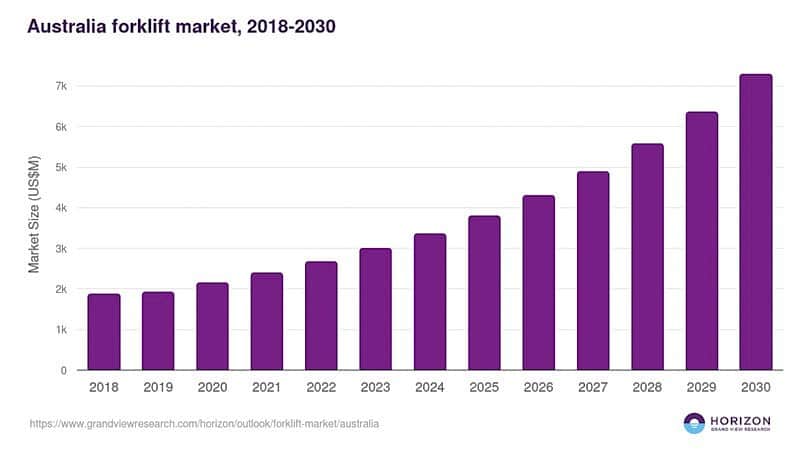
The LPG-powered forklift is a powerhouse that delivers seamless logistics across warehouses, retail hubs, and ports nationwide. Nearly 40% to 50% of the country’s active forklift fleet is powered by LPG, totaling tens of thousands of units operating every day.
Source: [10]
Market forecasts indicate this sector will generate USD 7 billion in revenue by 2030, fueled by demand for eco-friendly alternatives. The dominance of LPG-powered forklifts in industries is boiled down into three key points:
- Zero recharge downtime: Unlike electric-powered forklifts, LPG-powered forklifts are refueled in a few minutes, ensuring minimal downtime and continuous operation in working environments.
- Clean, safe combustion: LPG-powered forklifts emit almost 90% less particulate matter and 30% less CO2 than diesel-powered ones. This makes LPG-powered forklifts the preferable choice for indoor use and workplace health and safety standards [11].
- High power-to-weight ratio: They deliver better performance, with consistent torque and lift even in cooler warehouse conditions or when carrying higher loads.
LPG-powered forklifts’ reliability, easy refueling, and lower emissions make it a sound choice for industrial environments. It ensuring smooth material flow across industries while keeping workers safe and efficient.
Fueling Hospitality and Events
Aside from logistics, LPG cylinders also play a key role in Australia’s vibrant LPG hospitality and events sector. Small businesses, particularly those in food service and tourism, cover a large share of commercial LPG consumption.
From cafes on the Mid North Coast to large-scale stadium events in Melbourne, LPG is considered the go-to energy source for this sector. This is due to its reliability, portability, and superior energy storage.
- Restaurants and Cafes: LPG remains the preferred energy source by chefs as it offers instant heat control and high flame temperature. This is reflected in an industry survey where roughly 60% of professional kitchens remain reliant on gas. LPG cylinders also remain the standard fuel for cooking and water heating in off-grid and coastal regions [12].
- Food Trucks and Mobile Vendors: The increasing number of mobile dining options has further strengthened the role of LPG. It is the ideal energy source for food trucks due to its portability and safety.
- Major Events and Festivals: LPG also provide fast energy solutions for temporary catering events, outdoor heating, and lighting. As such, event operators prefer LPG because they value its portability, usability, and scalability.
Ensuring Energy Security for Australian Homes
Australia, with its vast, geographically diverse territories, make reliable energy access a highly sought-after commodity. For millions of Australians who live outside the natural gas network, LPG cylinders are foundational to every home’s energy independence and security.
One in four Australian households remains reliant on LPG for daily needs. These include cooking, water heating, and space heating, especially those living in regional and off-grid areas. With this continued dependency, about 7 million cylinders have been added to active circulation in 2019 [7].
In areas outside the natural gas network, LPG cylinders provide reliable, portable energy solutions. The 45kg cylinder is the most commonly used gas bottle variant. They are typically used in pairs to ensure an uninterrupted supply in homes with unreliable or no access to mains electricity.
Furthermore, LPG remains the primary cooking and heating fuel for hundreds of thousands of Australian homes, particularly in New South Wales, Queensland, and South Australia [12].
- Cooking: Home cooks and chefs prefer gas over electric stoves because they offer precise temperature control and instant heat [12].
- Hot Water: Continuous-flow LPG systems provide uninterrupted hot water without relying on high-voltage electricity, making them the go-to choice for properties without proper access to electricity.
- Heating: LPG heaters are the go-to choice for cooler climates, offering higher efficiency and lower emissions than wood- or diesel-fired systems.
A Confident Step Towards a Sustainable Future
As Australia’s energy mix continues to evolve quickly, so does LPG. BioLPG, also known as renewable LPG, is considered the next generation of clean, low-carbon fuel. It provides all the benefits of conventional LPG, but with much lower lifecycle greenhouse gas emissions [11][13].
What makes BioLPG better is that it is a ready-to-drop-in solution that can be easily fitted to existing cylinders, appliances, and distribution networks without any modification. That means no extra capital costs to homeowners, businesses or anyone switching to it.
Although BioLPG is chemically identical to traditional LPG and behaves the same, this makes implementation seamless to the existing LPG infrastructure across the country.
BioLPG could support both residential and commercial sectors in decarbonizing without compromising. This way, homes outside the natural gas mains range can access a sustainable energy option without paying for expensive infrastructure upgrades.
On the other hand, businesses that utilise LPG can switch to BioLPG, instantly reducing carbon emissions while retaining reliability and efficiency [11].
As the country aims to decarbonize towards a greener energy future, BioLPG ensures that gas bottles are part of the solution. Given that it combines the dependability of LPG with the sustainability of renewables, BioLPG is the core block to the country’s future decarbonization.
Australia’s World-Class Safety Record
The LPG industry in Australia operates under robust, rigorous safety standards, ensuring that every cylinder, appliance, and delivery meets strict national and international standards.
From manufacturing to installation and transport, the sector’s focus on safety and compliance has earned LPG a solid reputation for reliability and trustworthiness in the energy mix available to Australian homes and businesses.
The recorded incident rate in the LPG industry is less than 0.0001% per cylinder in circulation per year, suggesting an excellent performance across millions of active gas cylinders, both nationally and internationally [7].
With the industry’s adherence to Australian Standards for the storage and handling of LP gas and Work Health and Safety regulations, every stage of LPG handling meets the highest safety standards.
Consumer safety awareness also plays a crucial role in this low incident rate. Over 95% of LPG users in the country feel confident in the safety and reliability of their gas supplies, demonstrating a positive reaction to the industry’s transparency, education, and commitment to excellence [3].
This means that the LPG industry deserves national and global recognition. With strong regulation, continuous and strict oversight, and decades of proven reliability, the LPG industry upholds a safety standard that earns Australians’ trust daily.
Methodology & Sources for Australian Gas Bottle Statistics
[1] Pathway to zero emissions for LPG | Gas Energy Networks National Forum
[2] Gas Energy Australia – Annual Report 2023-2024
[3] LPG Statistics Australia (2025 Data & Forecast)
[4] The Australian LPG Industry September 2017
[5] PlusGas – Everything You Need to Know About LPG
[6] Australian Energy Statistics – Update Report 2025
[7] Gas Energy Australia – Annual Report 2024-2025
[9] Future Made in Australia: Unlocking Australia’s low carbon liquid fuel opportunity
[10] Australia Forklift Market Size & Outlook, 2024-2030
[11] STATISTICAL REVIEW OF GLOBAL LPG