
Australian Industrial LPG Statistics (Trends, Forecast & Usage)
The Headline Statistics Driving Industrial Energy Decisions
This is an in depth look at Australian industrial LPG statistics.
Industrial LPG is a core player in powering Australia’s broad industrial sectors, including manufacturing, transport, agriculture, and even commerce. As it fuels a myriad of industries, it explains why it is evolving into a smarter, greener part of the country’s energy mix.
While much of the national conversation is on renewables and electrification, LPG remains a major transitional fuel in the market. As full electrification has not yet been achieved, LPG is the frontrunner in reliability, lower emissions, and cost stability for sectors that demand uninterrupted energy.
Numerous industries across Australia depend on LPG for diverse applications. With its clean combustion, high efficiency, and adaptability, it is the lifeline in areas without electrification or gas mains.
Here is a list of recent critical Australian industrial LPG statistics:
- Roughly 3.6 million tonnes of LPG are consumed each year in Australia, with the industrial and commercial sectors responsible for more than 45% of total demand. [1]
- Australia is one of the top 10 LPG-producing countries in the world, locally generating over 7 million tonnes per year [2].
- LPG powers around 60,000 forklifts in the country, making it the most used energy source for materials handling due to its low indoor emissions and easy refueling [1].
- Australia’s local manufacturing sector takes up over 28% of the total industrial LPG consumption. Common uses include heating, cutting, drying, and metal treatment [1].
- Almost 85% of regional businesses outside the natural gas grid in Australia remain reliant on LPG cylinders or bulk storage to keep operations running smoothly and uninterrupted.
- With BioLPG, the country could reduce the industrial LPG emissions by up to 80% without any modification or infrastructure changes, ensuring a seamless pathway to sustainable operations [3].
Australian Industrial LPG Statistics by Sector: Where Australian Industry Uses LPG
Although the country is cutting the cord on fossil fuels, LPG usage remains a reliable backbone of industrial operations, powering everything from manufacturing plants to remote mining sites.
Its key features, like portability, high thermal efficiency, and low carbon emissions, make it a reliable and indispensable asset across the nation’s various sectors that need off-grid energy independence and consistent performance.
As industries continue to balance sustainability with operational cost pressures, LPG is still one of the few energy sources that offer economic and environmental advantages, making it a widely used fuel product.
Below is a bar graph that shows the traditional demand of LPG in Australia by sector:
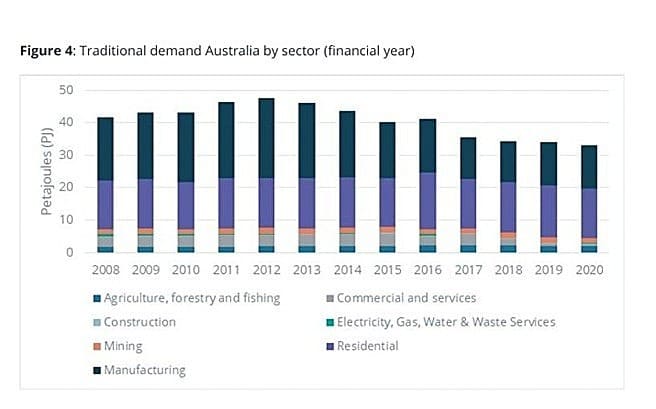
Source: [4]
From 2008 to 2020, two key sectors had noticeable impacts on the LPG scene in Australia. The residential sector has maintained its share of LPG demand for over a decade, indicating that residents remain dependent on LPG.
On the other hand, growths and dips are observed in the manufacturing industry. There have been noticeable jumps in demand in the first few years, but demand has since decreased, with the decline consistent in the succeeding years.
However, it is worth noting that the manufacturing sector adds to the existing 45% industrial LPG demand. It powers a fair share of the country’s manufacturing base, typically in metal fabrication, chemical synthesis, and food production.
The food and beverage sector alone covers 30% of overall LPG consumption in the manufacturing industry, primarily for ovens, kilns, and sterilisation [1][5].
LPG is the most sought-after energy source due to its superior features, including clean combustion and reduced corrosion of equipment across many sectors.
These key features further explain that the logistics and warehouse sector is responsible for 22% of the country’s LPG demand, covering over 60,000 forklifts nationwide.
This sector is the second-largest LPG consumer, with businesses preferring LPG-powered forklifts over electric units because of their easy refueling system, consistent power delivery, and suitability for both indoor and outdoor environments [6].
LPG’s flexibility reflects its position as an industrial workhorse, a highly in-demand fuel that impacts various sectors and businesses. It provides energy security, flexibility, and cleaner combustion, keeping the country’s economy running.
Why LPG Dominates Australian Materials Handling
LPG-powered forklifts are a mainstay in Australia’s fast-moving logistics, manufacturing, and retail supply chains sector. It has earned a reputation as the unrivalled workhorse of materials handling, favoured by many businesses over its electric counterpart.
More than 60,000 LPG forklifts are in current use, accounting for over 40% of the country’s overall forklift market. These machines are the centre of every logistics hub, supermarket distribution centre, and manufacturing plant nationwide [5][6].
The average running time of each forklift is about 8 to 16 hours per day, showing its importance in every business they are involved with. They are engineered for continuous, uninterrupted operation.
In industrial settings, the LPG-powered forklift dominated indoor and mixed-use environments due to its low emissions, easy refueling, and consistent power delivery. On the other hand, its electric counter requires 6 to 8 hours of charging per day, leading to increased downtime and decreased efficiency, especially when high-volume operations are expected.
Here are the reasons why LPG-powered forklifts outperform alternative-powered forklifts:
- Zero Downtime, Maximum Uptime: Changing an LPG cylinder takes less than a minute to replace or refuel, ensuring continuous operations without any disruption. Electric forklifts have long charge times and declining power output as their batteries begin to discharge [6].
- Consistent Performance: LPG-powered forklifts offer steady torque and lifting power, even under heavy loads, where electric motors struggle, especially when their batteries deplete over the shift [7].
- Lower Indoor Emissions: When compared to diesel-powered forklifts, LPG forklifts emit up to 90% less particulate matter and 30% less CO2 emissions.
- Ease of Refueling Infrastructure: Warehouses and manufacturing sites do not have to invest in expensive charging stations or complex fuel management systems, as they can easily and safely store bulk LPG or use an exchange cylinder system, which is more cost-efficient [7].
Delivering Reliable, High-Intensity Heat for Manufacturing
Aside from dominating the materials handling sector, LPG is a powerhouse as a clean, high-performance energy source for process heat, an important process in manufacturing.
As electricity prices rise and grid stability challenges intensify, LPG offers industries a reliable, responsive, and efficient energy source that keeps their production lines running uninterrupted and without issues.
This sector alone accounts for almost 35% of the country’s LPG demand, with a large portion of it used for process heating. It can achieve flame temperatures exceeding 1,900°C and a thermal efficiency exceeding 90% [1].
The high energy density of LPG makes it the best energy source for applications that require quick, controlled heating, such as food and beverage processing, metal fabrication, and the production of building materials.
For many manufacturers, LPG’s independence from the grid provides a competitive advantage for those who use it. Whenever grid outages or voltage fluctuations occur, the grid can instantly cause production delays or, in the worst-case scenario, stop production. This leads to expensive downtime and potential batch losses.
Recent reports indicate that several industries are increasingly relying on off-grid or hybrid fuel systems to sidestep potential power supply risks. LPG’s key features, such as portability and flexible storage options, make it the ideal solution for industries and manufacturing zones to deliver high-performance heat almost anywhere in Australia [1].
LPG delivers the heat that the industries can count on. It is precise enough for numerous processes, powerful enough for metallurgy, and flexible enough to be deployed nationwide.
It remains a smart, reliable, and scalable solution for industrial process heating. As such, LPG is a core fuel not only in logistics but also on production lines in Australia [8].
A Smarter Bottom Line With LPG
For businesses in Australia, energy is not only a utility but also what shapes financial outcomes. Due to its volatility in the previous years, electricity and diesel prices have pushed industries to reconsider their energy mix in favour of cost predictability, stability, and long-term value.
This has led numerous industries to consider LPG as their major energy source because of its established supply infrastructure, high energy efficiency, and stable pricing, making it a standout as a well-thought-out energy investment rather than an operational expense.
When comparing the total cost of ownership of industrial heat systems, LPG-powered equipment is generally more cost-effective than its electric equivalent because of its significantly lower energy costs.
The table below is a long-term total cost of ownership analysis for an LPG-powered boiler and an electric alternative:
| Factor | LPG Boiler | Electric Boiler |
| Capital Cost and Installation | Higher upfront cost | Lower upfront cost |
| Energy Cost | Lower per unit of energy | Higher per unit of energy |
| Efficiency | High | Very High |
| Maintenance and Lifespan | Higher maintenance needs | Lower maintenance needs |
| Capacity and Suitability | Suitable for larger properties | Better suited for smaller properties |
Source: [9]
Provided this table, let us break down each factor and its impact on the total cost of ownership.
On capital and installation costs, electric is initially cheaper, with a lower upfront cost and a simpler installation procedure that requires only a power supply. On the other hand, an LPG boiler has a higher upfront cost and requires a gas supply installation.
In terms of energy costs, an LPG boiler is cheaper because it utilises LPG, which is typically 3-4 times cheaper per kWh than electricity in most regions, making it readily available for regions that rely on LPG for electrification. Electric boilers cost more, making them the largest long-term cost driver [10].
When it comes to efficiency, both models excel: the LPG boiler has an efficiency of 90-95%, while its electric alternative has an efficiency of 99-100%, driven by its much higher electricity price per kWh.
On maintenance and lifespan, the electric boiler has lower maintenance needs and a longer lifespan of 15 to 25 years, compared to LPG’s higher maintenance needs and a lifespan of 10 to 15 years [9].
For capacity and suitability, LPG is better suited to larger properties with high heat or hot water demands, as it can efficiently meet those. Electric boilers, however, are generally better suited for smaller properties with lower heating needs [10].
Overall, the LPG boiler offers a much lower long-term total cost of ownership in most situations, primarily because the savings it delivers on running costs quickly offset its higher initial and maintenance costs.
Sustainable Future: Industrial Decarbonization with BioLPG
As industries in Australia begin to decarbonize, the emergence of sustainable fuels serves as a practical, viable bridge to a low-carbon future. BioLPG rises above the pack of renewable fuels, a drop-in replacement for conventional LPG that delivers identical performance, reliability, and energy density.
BioLPG can achieve lifecycle greenhouse gas emissions up to 80% lower than those of fossil-fuel-derived LPG. It is produced from renewable feedstocks such as waste oils, plant residues, and biogenic fats, while retaining the chemical structure of LPG. That means it is compatible with existing LPG storage, transport, and combustion systems without requiring any modifications [11].
When compared to other conventional fuels, BioLPG has lower CO2 emissions. It emits 15 kg of CO2 per GJ, which is lower than LPG’s 59 kg per GJ. This highlights BioLPG’s clean combustion capabilities, outperforming grid electricity and diesel [12].
BioLPG & Compliance
For industries looking into ESG compliance and carbon reporting, BioLPG offers a straightforward, measurable path forward. BioLPG has been identified as a key contributor to achieving net zero by 2050.
This is further strengthened by its seamless integration into the country’s current fuel mix, without the need to retrain, retool, or redesign existing appliances or equipment.
While the national energy transition poses difficulties for some industries, BioLPG stands out as a readily available renewable, mature enough to meet the rising future energy demand. It offers cost-efficiency and a low-risk decarbonization pathway, safeguarding productivity while advancing sustainability goals.
In a market where carbon credibility matters more than ever, BioLPG has empowered businesses to lead the change, enabling both industry and sustainability to burn bright together toward a cleaner Australian future.
Methodology & Sources for Australian Industrial LPG Statistics
[1] Gas Energy Australia – Annual Report 2024-2025
[2] Department of Industry, Science, Energy and Resources – Australian Energy Update 2021
[3] Statistical Review of Global LPG
[4] Frontier Economics – Pathway to Zero Emissions for LPG
[5] Gas Energy Australia – Annual Report 2023-2024
[6] Globenewswire – Forklift Market Outlook, Trends and Growth Analysis Report 2025-2034
[7] Department of Energy – Full Fuel-Cycle Comparison of Forklift Propulsion Systems
[8] Australian Gas Infrastructure Group – Building Electrification Regulatory Impact Statement
[9] Coalbiomassboiler – What Are the Capital Costs vs. Operational Costs of Steam Boilers?
[10] Industrial Demolition Statistics & Work Report